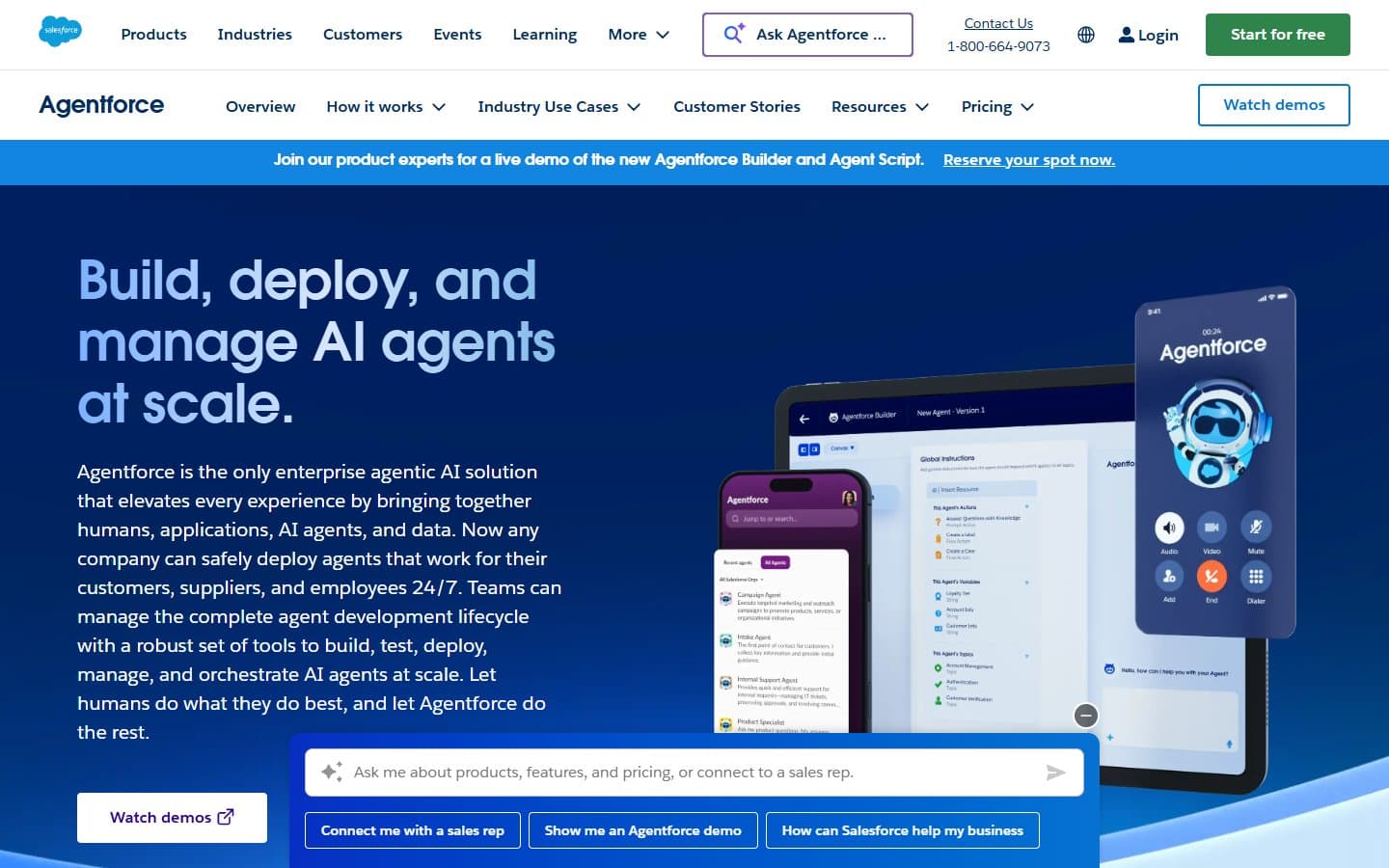
Agentforce is AI automation that lives inside Salesforce CRM. It works well if you're already a Salesforce customer, but it's useless if you're not. The pay-per-conversation pricing makes budgeting tricky.
Who Agentforce Is Best For
You need to be a Salesforce customer first. That's non-negotiable.
Beyond that, Agentforce works best for businesses handling repetitive customer interactions. Sales teams that qualify hundreds of leads monthly will see real value. Service teams drowning in basic support tickets can offload tier-1 questions.
Marketing teams running active campaigns benefit from automated response handling. But you need enough volume to justify the per-conversation costs.
What Agentforce Actually Does
Agentforce creates AI agents that handle customer conversations across sales, service, and marketing. These aren't chatbots—they're connected to your actual Salesforce data.
The sales agent qualifies leads by asking discovery questions and updating your CRM records. It can schedule meetings and hand off warm prospects to your sales team.
The service agent answers common questions using your knowledge base. It escalates complex issues to humans and logs everything in Salesforce cases.
The marketing agent responds to campaign inquiries and nurtures leads through automated sequences. It tracks engagement and updates contact records.
You build agents using Salesforce Flow's visual builder. No coding required, but you need to understand Salesforce's data structure. The agents deploy across email, chat, SMS, and phone channels.
Agentforce Pricing
You pay $2 per conversation. A conversation includes the full back-and-forth exchange until it ends or transfers to a human.
This pricing model is both good and bad. You only pay for actual usage, which helps small businesses avoid big monthly fees. But costs become unpredictable if your agents get chatty or customers ask follow-up questions.
A single customer might generate multiple conversations in one session if they switch topics. Each topic shift starts a new $2 charge.
You also need a Salesforce subscription, which starts around $25 per user monthly. Factor that base cost into your calculations.
What We Like
The Salesforce integration is the biggest advantage. Your agents access real customer data, purchase history, and case records. They provide personalized responses instead of generic chatbot answers.
The no-code builder makes agent creation accessible. You drag and drop conversation flows and connect them to Salesforce objects. Most Salesforce admins can figure it out.
Human handoff works smoothly. Agents know when to escalate and pass complete conversation context to your team. No frustrating "please repeat your issue" moments.
The Einstein Trust Layer adds important safety guardrails. It prevents agents from sharing sensitive data or going off-script in harmful ways.
Conversation analytics show you exactly what customers ask about most. You can identify knowledge gaps and improve your agents over time.
What We Don't Like
The Salesforce requirement kills this for most small businesses. You can't use Agentforce with other CRMs or as a standalone tool. If you're on HubSpot, Pipedrive, or any other platform, you're out of luck.
Per-conversation pricing creates budget anxiety. One viral social media post driving hundreds of support questions could generate a surprise bill. You can't predict monthly costs.
The Flow builder, while no-code, still requires Salesforce expertise. You need to understand objects, fields, and workflows. Many small business owners will need outside help.
Agent responses can feel robotic despite the AI branding. They follow predetermined paths and struggle with nuanced requests that fall outside their training.
How Agentforce Compares to Alternatives
Intercom and Zendesk offer similar AI agents with more flexible CRM integrations. They work with multiple platforms, not just their own ecosystem.
ChatGPT Plus costs $20 monthly and handles more complex conversations. But it doesn't integrate with your business data or CRM.
HubSpot's ChatBot tool costs less and integrates with their free CRM. The AI capabilities are more limited, but the barrier to entry is much lower.
Microsoft Copilot works across multiple business applications for $30 per user monthly. It's more expensive but much more versatile.
Should Your Business Use Agentforce?
Only if you're already committed to Salesforce and handle high volumes of routine customer interactions.
If you're paying for Salesforce anyway and your team spends hours on repetitive questions, Agentforce makes sense. The time savings justify the per-conversation costs.
Skip it if you're not on Salesforce or don't have predictable conversation volumes. The pricing uncertainty and platform lock-in aren't worth it for most small businesses.
Also skip it if your customer interactions require high-touch, personalized responses. Agentforce works for routine tasks, not complex problem-solving.
FAQ
Does Agentforce work without Salesforce?
No. You must have an active Salesforce subscription. Agentforce is built into the Salesforce platform and can't operate independently.
How do you control per-conversation costs?
Set conversation limits in the admin settings and monitor usage through Salesforce reports. You can pause agents if costs exceed your budget.
Can agents access all Salesforce data?
Agents only access data you explicitly grant through permission sets. You control which objects, fields, and records each agent can view or modify.
What happens when agents can't answer questions?
Agents escalate to human team members and pass along the full conversation history. You can customize escalation rules based on keywords or sentiment.