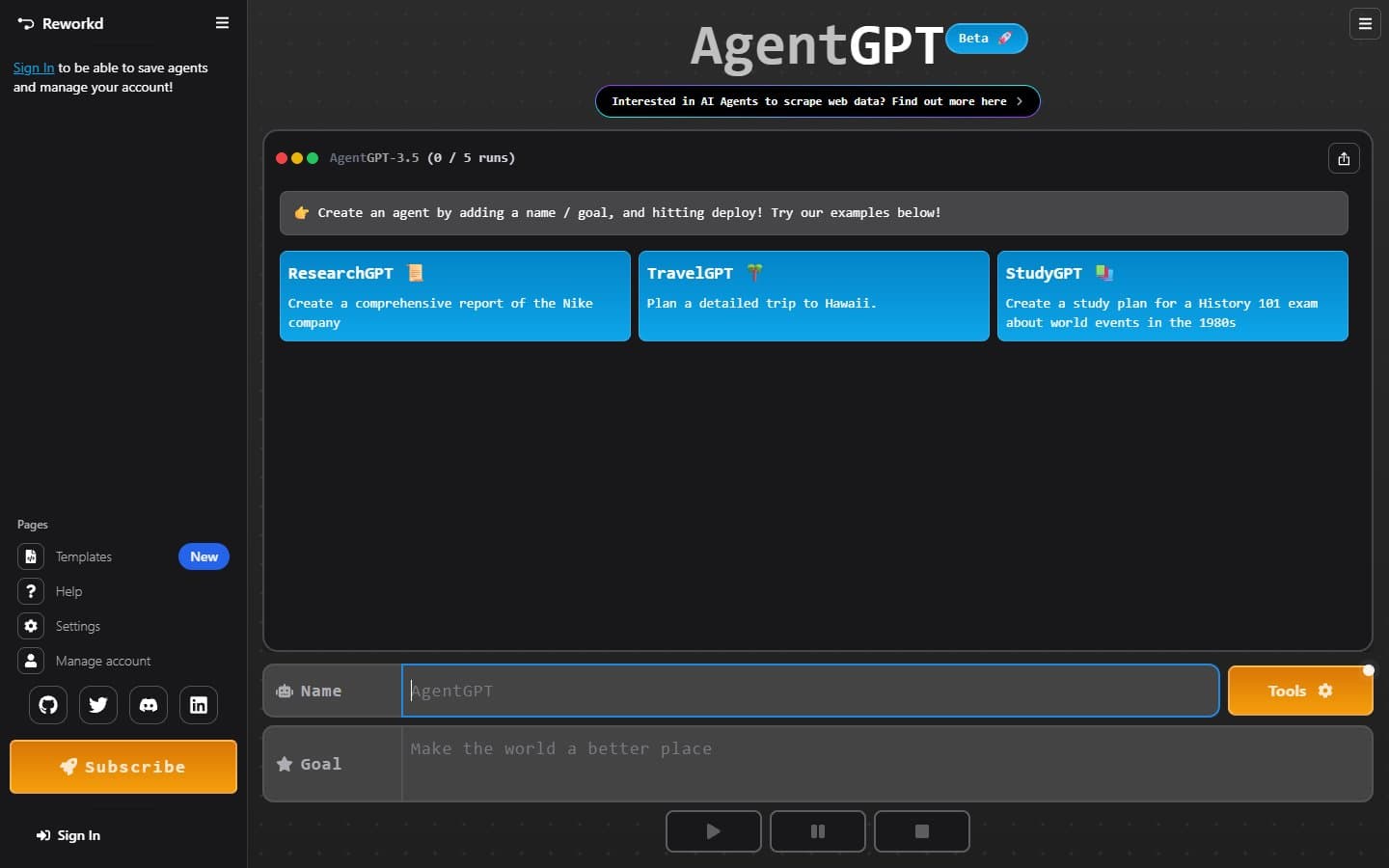
AgentGPT creates autonomous agents that tackle complex tasks independently. But the results are wildly unpredictable. Skip this unless you have time to experiment and technical skills to troubleshoot constant failures.
Who AgentGPT Is Best For
You'll get the most value from AgentGPT if you're a developer or technical founder who wants to prototype autonomous workflows. It's perfect for one-off research projects where you can afford inconsistent outputs.
Small teams doing competitive analysis or market research might find it useful for initial data gathering. Just don't expect polished, ready-to-use results.
If you're not comfortable debugging AI outputs or don't have time to babysit experimental technology, look elsewhere.
What AgentGPT Actually Does
AgentGPT creates AI agents that work independently toward goals you set. You give it a task like "research our top 5 competitors' pricing strategies," and it breaks this into subtasks. It finds competitors, visits their websites, analyzes pricing pages, and compiles results.
The agents can browse the web, execute code, and maintain context across multiple steps. You can run several agents simultaneously and access everything through your browser.
Unlike traditional AI tools that require step-by-step prompting, these agents make their own decisions about how to approach problems. This autonomy is both the platform's biggest strength and weakness.
AgentGPT Pricing
The free tier gives you limited monthly runs using GPT-3.5, which is enough to test basic functionality. Results with GPT-3.5 are noticeably worse than GPT-4, so the free version feels more like a demo.
The Pro plan costs $40 monthly and includes unlimited runs, GPT-4 access, priority processing, and API access. That's reasonable pricing if you use it regularly, but expensive for occasional experiments.
No enterprise pricing exists, which tells you everything about their target market.
What We Like
The goal decomposition feature works surprisingly well. AgentGPT breaks complex tasks into logical subtasks better than we expected, often identifying steps we hadn't considered.
Running multiple agents simultaneously saves time on parallel research tasks. You can have one agent researching competitors while another analyzes industry trends.
The browser-based interface requires no installation or complex setup. You create an account and start building agents immediately.
API access in the Pro tier lets developers integrate AgentGPT into existing workflows, which adds flexibility for technical users.
What We Don't Like
Consistency is AgentGPT's biggest problem. Run the same task twice and you'll get different approaches and results. This unpredictability makes it unsuitable for any business process requiring reliable outputs.
The agents often get stuck in loops or pursue irrelevant tangents. We watched an agent spend 20 minutes researching the wrong company because it misunderstood the initial goal.
Error handling is poor. When agents fail, you get minimal information about what went wrong or how to fix it. Debugging failed runs wastes significant time.
No security controls exist for business data. Everything runs through AgentGPT's infrastructure with no options for private deployment or data residency controls.
How AgentGPT Compares to Alternatives
ChatGPT with browsing capabilities gives you more control over research tasks. You guide each step and catch errors immediately. It's slower but far more reliable.
Zapier and Make.com offer structured automation that actually works for business processes. They lack AI sophistication but deliver consistent results.
For coding tasks, GitHub Copilot and Cursor provide AI assistance within familiar development environments. They're more practical than AgentGPT's experimental code execution.
Custom GPT assistants give you AI help with specific business tasks while maintaining predictable behavior.
Should Your Business Use AgentGPT?
Most small businesses should skip AgentGPT. The technology is impressive but too unreliable for operational use. You'll spend more time fixing agent mistakes than you'll save from automation.
Consider AgentGPT only if you're in a technical field and want to experiment with autonomous AI. Budget significant time for testing and iteration.
If you need reliable AI assistance, stick with established tools like ChatGPT Plus or Claude Pro. They require more manual input but deliver consistent quality.
For business automation, use proven platforms like Zapier or hire developers to build custom solutions.
FAQ
Is AgentGPT safe for business data?
No. Everything processes through their servers with no privacy controls. Don't input confidential information.
Can non-technical users succeed with AgentGPT?
Unlikely. The platform requires troubleshooting skills and patience with experimental technology. Most business users will find it frustrating.
How long do agent tasks typically take?
Simple tasks finish in 5-10 minutes, complex research can take 30+ minutes. Many tasks fail partway through and require restarts.
Does AgentGPT work offline?
No. It's entirely cloud-based and requires internet connectivity for all operations. No on-premises deployment options exist.