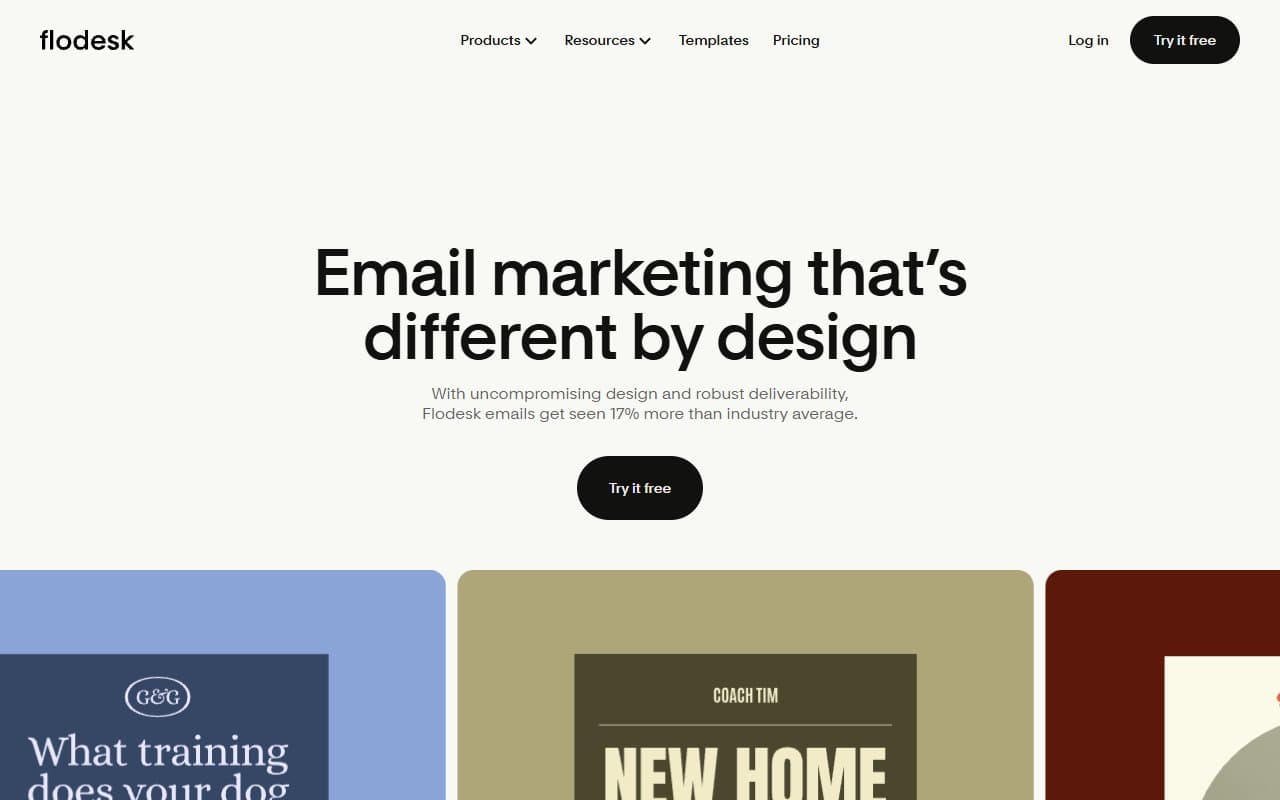
Sarah's handmade jewelry business was struggling to convert website visitors into customers until she started using Flodesk's stunning email templates to showcase her pieces - her first welcome series featuring beautiful product photography resulted in a 40% increase in sales within two weeks, making the $38 monthly investment pay for itself.
Most email marketing tools are secretly the same product wearing different logos. They compete on automation depth, deliverability statistics, and integration counts — and they all quietly assume you have a marketing team to run them. Flodesk made a different bet: that most small business owners just want emails that look good and go out on time.
Who Should Use Flodesk
If you're a photographer sending client welcome sequences, a business coach nurturing leads between launches, or an Etsy seller building a loyal audience, Flodesk was built for your exact workflow. The interface assumes you are one person doing five jobs, not a marketing coordinator with three hours to build a campaign.
A yoga instructor with a 2,000-person list will get more from Flodesk than a mid-sized e-commerce brand with 50,000 SKUs. The same applies to freelance designers, wedding planners, nutritionists, online course creators — anyone whose business runs on personal brand and relationship-building rather than transactional volume. If your emails are part of the product, not just a promotional channel, this tool fits.
Where it breaks down: if you're running a Shopify store with abandoned cart sequences, post-purchase upsells, and product-specific segmentation, Flodesk will frustrate you before month's end. It isn't built for that use case, and the company has never pretended otherwise.
What It Actually Does
Flodesk lets you build, send, and automate email campaigns through a drag-and-drop editor that is genuinely easier to use than most tools in this category. You start with a template — and the template library is the best in the business at this price point — then edit it to match your brand, add your copy, and either send it immediately or drop it into a workflow.
The workflows handle your automation: welcome sequences, lead magnet delivery, course drip content. You can embed signup forms on your website or use Flodesk's landing page builder to capture new subscribers. There's also a checkout feature for selling digital products directly, which keeps everything in one place. The platform takes about thirty minutes to understand, and that's not an exaggeration — it genuinely is that approachable.
Pricing
Flodesk runs a single paid tier at $38/month, covering everything: unlimited subscribers, unlimited emails, all templates, workflows, forms, and checkout pages. No subscriber-count tiers, no feature gating, no nasty surprises when your list crosses 10,000.
For a business with a growing list, this is legitimately excellent value. Mailchimp charges more than double once you pass 5,000 subscribers, and you still won't get templates this good.
What you don't get is a free plan. There's a 30-day free trial, but if you're hoping to run a small list for free indefinitely, this isn't your tool. For a brand-new business with under 200 subscribers and no immediate revenue tied to email, the $38/month is hard to justify. Give it six months and come back.
What Works Well
The template library is genuinely excellent. Most email template libraries are either outdated or so generic they're useless. Flodesk's are current, visually distinctive, and — critically — they actually look like the preview when sent. That saves real editing time on every campaign.
Flat-fee pricing removes a growth tax. Every other major platform charges you more as your list grows, creating a perverse incentive to prune subscribers you might actually need. At $38/month regardless of list size, you stop worrying about it.
The learning curve is almost flat. First-time users with no email marketing background consistently get their first campaign out within an hour. The interface earns it.
What Does Not Work
Segmentation is rudimentary. You can tag subscribers and filter by basic criteria, but if your business needs to send different content based on purchase history, behavioral triggers, or multi-condition logic, Flodesk hits a wall fast. This is the tool's most significant limitation for anyone scaling beyond a simple list.
Reporting gives you the basics and nothing else. Open rates, click rates, unsubscribes — it's all there. What's missing is any meaningful analysis beyond those surface numbers. You can't easily identify which automation step is losing people or compare campaign performance over time without exporting data manually.
How It Compares
Mailchimp has deeper segmentation and a free entry tier, but the interface is cluttered, the templates are weaker, and the pricing gets punishing as your list grows. Choose Mailchimp if you need complex automations or want free for a tiny list.
ConvertKit is the stronger tool for serious content creators who need sophisticated tagging and subscriber journeys. It's also pricier. Choose Kit if email is your primary revenue channel and you need granular control.
Klaviyo is in a different category entirely — built for e-commerce, priced accordingly. Don't compare the two.
The Verdict
If you run a service business, sell digital products, or build a personal brand, Flodesk is one of the most sensible purchases you can make at $38/month. The templates alone remove a recurring friction point that kills most small business email programs before they start. The flat pricing means you're not penalized for success.
If you're running a product-based business with complex customer segments, need deep behavioral automation, or require detailed analytics to justify your marketing spend — go to Kit or Klaviyo instead. You'll outgrow Flodesk before you've used it properly.
For the creative entrepreneur who just wants professional-looking emails to go out consistently without spending half a day on them, Flodesk is the right tool at the right price.
Common Questions
Does Flodesk have a free plan?
No. There's a 30-day free trial with full access, but no permanent free tier. If you need free indefinitely, Mailchimp's free plan supports up to 500 contacts, though the feature restrictions are significant.
Is Flodesk good for e-commerce?
Not really. The checkout feature handles simple digital product sales, but if you're running a Shopify or WooCommerce store with product-based sequences and abandoned cart flows, Flodesk's automation won't cover what you need. Klaviyo or Omnisend will serve you better.
Can Flodesk handle a large email list?
Yes — unlimited subscribers is the whole point of the flat-fee model. The platform handles large lists without performance issues. The caveat is that managing a large, diverse list well requires segmentation tools that Flodesk currently doesn't offer at a sophisticated level.
How does Flodesk compare to Mailchimp on price?
At small list sizes, Mailchimp is cheaper or free. Once your list passes roughly 5,000 subscribers, Flodesk's $38 flat fee becomes the better deal — and stays better indefinitely as you grow.