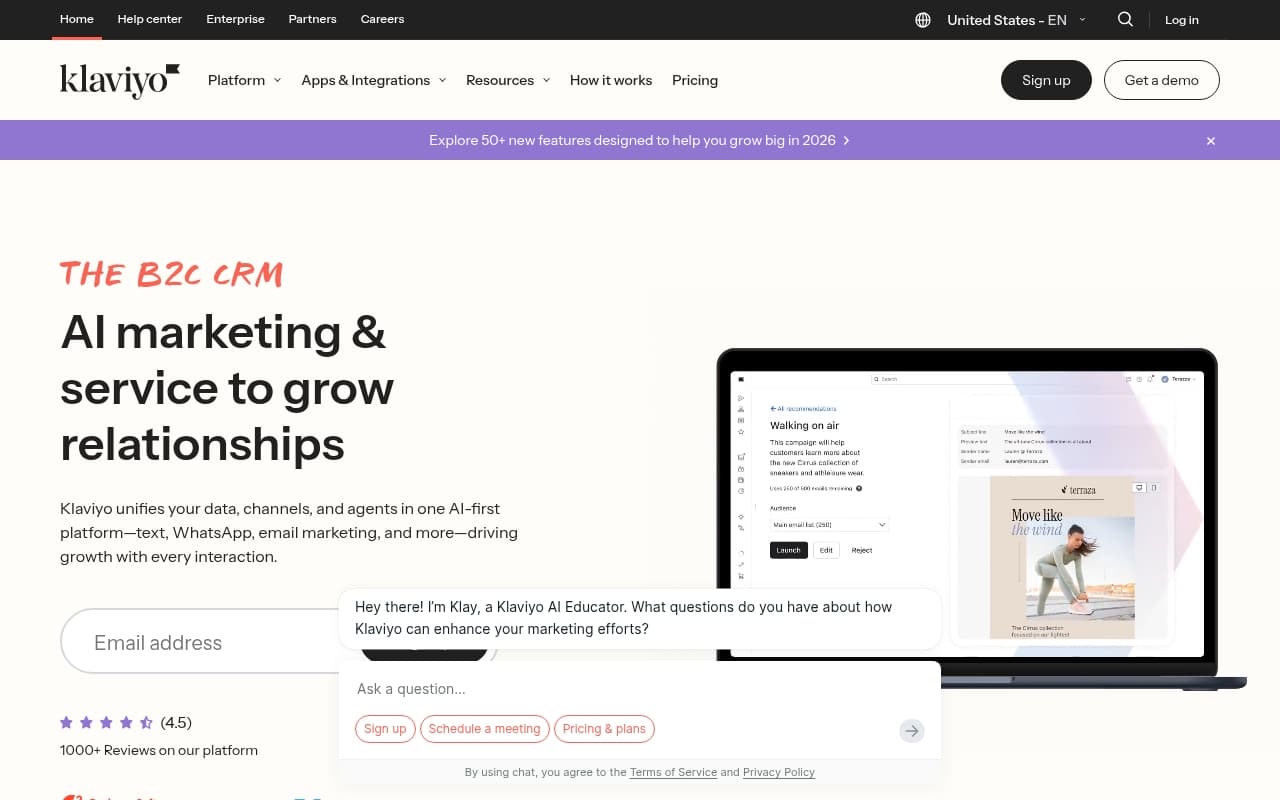
Attentive gets all the press in SMS marketing. It has the slicker sales team, the shinier case studies, and the enterprise reputation. What it lacks is Klaviyo's native email integration — and for small e-commerce businesses, that gap matters more than most people realise.
Who Should Use Klaviyo (SMS)
If you run a Shopify store doing $200K to $5M annually, Klaviyo SMS deserves serious attention. You probably already send abandoned cart emails. Now imagine triggering an SMS thirty minutes after that email goes unread, with the customer's first name and the exact product they left behind. That's not hypothetical — that's what this tool does without custom setup.
Subscription box operators fit particularly well. Your customers have already opted into a relationship with you. They expect to hear from you regularly. SMS open rates in that segment routinely hit 90%, and Klaviyo's personalisation tokens mean you can reference subscription tier, renewal date, or last order without manual work.
B2B companies and service businesses without proper online storefronts should look elsewhere. Klaviyo SMS is built entirely around transactional and promotional triggers tied to purchase behaviour. If you're a 12-person accountancy firm trying to remind clients about tax deadlines, you'll fight the tool constantly. It wasn't designed for you.
What It Actually Does
Klaviyo SMS sends text messages to your customers — but the real value isn't the texting itself. Any tool can send a text. What Klaviyo does differently is connect those texts to everything else you already know about a customer: what they bought, when they bought it, how much they spent, whether they opened your last email, and whether they're about to lapse.
You build flows — automated sequences — that trigger based on customer behaviour. Someone buys for the first time, they get a welcome text. Someone hasn't ordered in ninety days, they get a win-back offer. A product goes back in stock, the people who wanted it get a message within minutes. You can run email and SMS inside the same flow, so the two channels work together rather than cannibalising each other. Compliance tools handle opt-in and opt-out automatically, which matters when legal exposure is involved.
Pricing
Klaviyo's SMS pricing is usage-based, layered on top of your existing Klaviyo email plan. The free plan gives you 150 SMS credits per month — enough to test the setup, not enough to run real campaigns. Consider it a trial with a time limit measured in sends, not days.
For a store with 5,000 SMS subscribers sending two campaigns monthly plus basic flows, expect to spend $100–$150 per month. That's reasonable for what you get. Where it gets painful is at higher volumes — large flash-sale sends to a 20,000-person list can spike your monthly bill quickly, and the pricing page doesn't make this obvious upfront. Start on the lowest paid tier, use flows heavily before campaigns, and monitor credit burn weekly for your first two months.
What Works Well
Email + SMS in one workflow. Running both channels from a single platform means you stop guessing which channel does the work. You can see — in the same dashboard — that your SMS follow-up recovered 14% of abandoned carts your email missed. That visibility alone justifies a significant portion of your monthly fee.
Shopify integration connects in fifteen minutes. Unlike tools that require a developer to configure the data sync, Klaviyo connects to Shopify quickly and pulls customer, order, and product data automatically. Your personalisation tokens populate correctly from day one, which isn't something you can take for granted with competing tools.
Compliance handling is thorough. Opt-out processing, quiet hours, and carrier compliance rules are built in and enforced automatically. For a small business owner without a legal team, that protection isn't a minor convenience — it's what stands between you and a regulatory headache.
What Doesn't Work
Credit-based pricing creates budget chaos. If you run an unplanned promotion or a flow triggers more than expected, your costs jump with no warning. Attentive and Postscript both offer more predictable pricing structures at comparable volumes. This is a genuine operational frustration that will catch you off-guard.
SMS-only reporting is thin. Klaviyo's combined email-and-SMS reporting is strong. Pull out SMS in isolation, and the analytics feel weak. Conversion attribution across channels is harder to parse than it should be, and for a business trying to justify SMS spend to a sceptical co-owner, the data you need isn't always surfaced clearly.
How It Compares
Attentive is the enterprise choice. It has dedicated SMS focus, superior analytics, and support that treats you like a real account. But it prices like an enterprise tool, and the minimum spend puts it out of reach for most businesses under $2M revenue. Choose Attentive if SMS is your primary channel and budget isn't the constraint.
Postscript is Shopify-native and worth considering if SMS is your only priority. It's simpler to learn than Klaviyo and has strong segmentation. Choose Postscript if you're not using Klaviyo email and never plan to.
Omnisend competes on price and covers email, SMS, and push notifications. It makes sense for very small stores on tight budgets. It lacks Klaviyo's segmentation depth beyond basic use.
The Verdict
If you run an e-commerce store on Shopify, already send email through Klaviyo, and have at least 1,000 customers you could SMS today — activate this immediately. The incremental cost is low, setup takes hours rather than days, and abandoned cart recovery alone typically pays for the channel within the first month.
If you're starting from scratch without an existing Klaviyo email account, do the maths carefully. You'll be paying for two products bundled together. Postscript may serve you better at lower volumes until your list justifies the combined investment.
If you're in B2B, professional services, or any business where purchases are infrequent and relationship-driven, don't bother. The tool will technically work, but you'll be paying for sophistication you can't use.
Klaviyo SMS is the right tool for one kind of business — but if you are that kind of business, it's very much the right tool.
Common Questions
Does Klaviyo SMS work without Klaviyo email?
Technically yes — you can use SMS as a standalone product. In practice, you lose most of the value, which comes from combining both channels in unified flows. If you only want SMS, Postscript or Attentive will serve you better at lower cost.
How does Klaviyo handle SMS compliance and opt-outs?
Opt-outs process automatically when a customer replies STOP, and quiet hour rules are enforced by default based on the recipient's time zone. You can't accidentally send to someone who has opted out. This happens in the background — you don't manage it manually.
Is the free plan actually useful?
For testing your setup and confirming integrations work, yes. For running live campaigns, 150 credits disappears fast. Budget at least one month of paid credits before you evaluate whether the channel works for your business — you can't draw conclusions from a test that small.
Can I send MMS (images) through Klaviyo SMS?
Yes, Klaviyo supports MMS for markets where it's available, including the US. Product images and GIFs can be included in campaigns and flows. Bear in mind MMS messages consume more credits than standard SMS, so factor that into your cost estimates before building image-heavy campaigns.