Sarah's handmade jewelry Shopify store was losing 70% of visitors without a purchase until she used Privy's exit-intent popups to offer a 10% discount, immediately recovering 15% of abandoning customers and boosting her monthly revenue by $2,400.
You built a Shopify store. You drove traffic to it. And then you watched people leave — no email, no follow-up, no second chance. That is the specific problem Privy was built to fix, and it does it better than most tools in this space.
Who Should Use Privy
If you run a direct-to-consumer brand on Shopify with somewhere between a few hundred and a few thousand orders a month, Privy was designed with your exact situation in mind. You do not have a dedicated marketing team. You do not have weeks to spend configuring a platform. You need email capture working this week and abandoned cart emails running by next week. Privy gets you there without a consultant or a YouTube rabbit hole.
First-time e-commerce owners will find the learning curve genuinely manageable. The platform assumes you know your product, not your marketing stack — and that is a deliberate design choice you will appreciate at 11pm when you are trying to set up your first automation. The Shopify connection means your store data is already there when you log in; you are not spending three hours syncing product catalogues or troubleshooting connections.
Where Privy fails is for stores that have scaled past simple segmentation. If you need behavioural triggers based on lifetime value tiers, multi-step conditional logic, or deep integration with a CRM, you will hit Privy's ceiling within a month. For those stores, the conversation changes — but that is covered below.
What It Actually Does
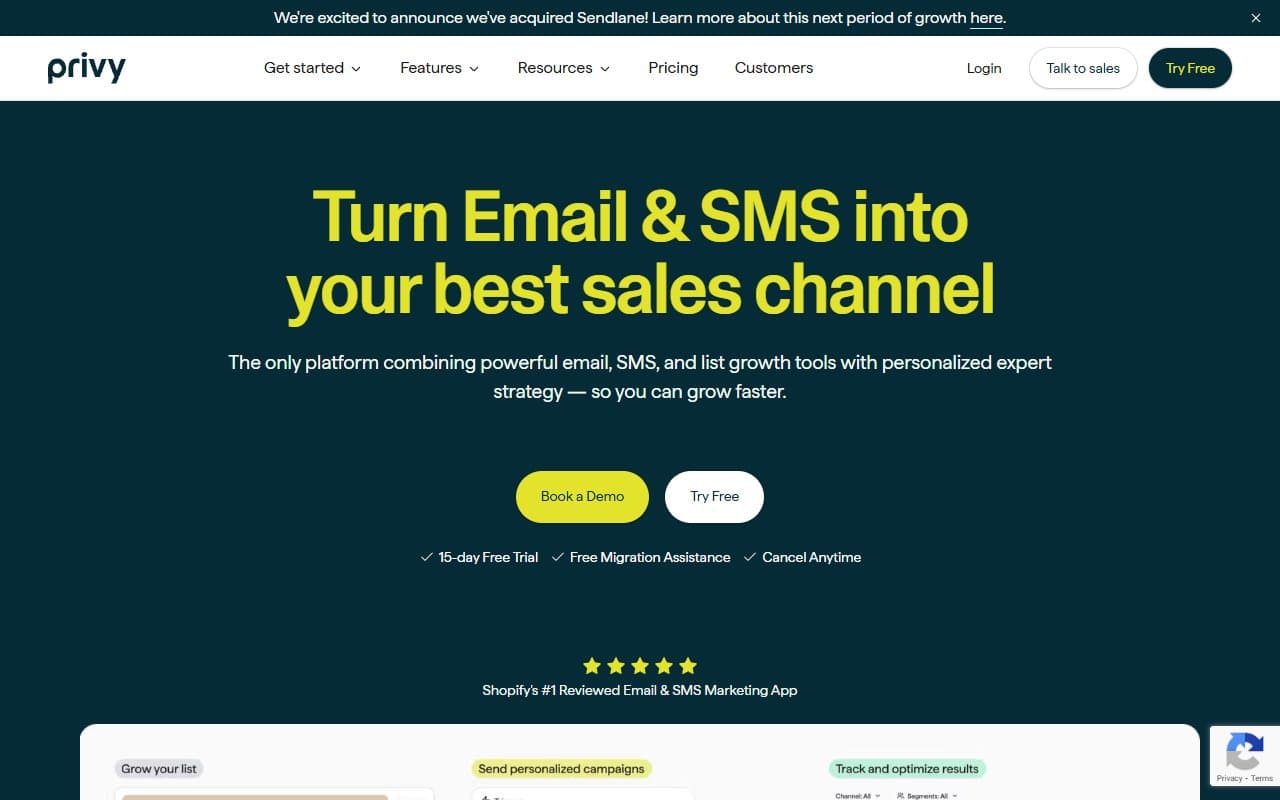
Privy sits between your Shopify store and your customers and gives you three main tools: pop-up forms to capture emails and phone numbers, email automations to follow up automatically, and SMS marketing to reach people on their phones.
The pop-ups are the headline feature. You create a form — could be a standard discount offer, a spin-to-win wheel for the gamification crowd, or a simple newsletter sign-up — and it appears to visitors based on rules you set. Someone about to leave? Show them an offer. First-time visitor? Offer them 10% off. Someone who has been browsing for two minutes? Catch them before they overthink it.
The email side handles the sequences that matter most to e-commerce: welcome series, abandoned cart recovery, post-purchase follow-up. SMS works alongside email rather than replacing it. Everything connects to your Shopify data, so product information, order history, and cart contents populate automatically when you build a campaign.
Pricing
Buy the $30 per month entry plan. It covers pop-ups and basic email for up to 1,500 contacts, and for a brand-new store still building its list, that is exactly what you need. Once you factor in abandoned cart recovery — which typically pays for the subscription within the first recovered order — the math works in your favour quickly.
The pricing scales with your contact list size, which is standard but worth watching. A store with 10,000 contacts will pay meaningfully more, and at that volume you should run the numbers against competitors like Klaviyo. SMS costs extra per message, so if you plan to lean heavily on text marketing, build that into your budget before committing.
Resist the urge to jump tiers until you have actually used the features at the base level. Many store owners sign up, run one pop-up, and realise they needed the basics done well more than they needed advanced features they were not ready to use.
What Works Well
Shopify integration connects cleanly. Most tools claim native Shopify integration and then make you map fields manually for an hour. Privy connects cleanly — your products, orders, and cart data are available immediately, which means your first abandoned cart email can be live the same day you sign up.
The spin-to-win feature actually converts. It sounds gimmicky, and if you had told me five years ago I would recommend a gamified pop-up with a straight face, I would have doubted myself. But the data from stores using it is hard to argue with — engagement rates on spin-to-win consistently outperform static discount pop-ups, often significantly.
Automations require almost no technical knowledge. The pre-built flows for welcome series and abandoned cart are ready to customise and deploy in under an hour. For a solo founder doing everything themselves, that is the difference between actually having email marketing and indefinitely planning to set it up.
What Does Not Work
Segmentation hits a wall immediately. If you want to target customers based on purchase history, product categories, or anything beyond basic demographic filters, Privy falls apart. For a store with a diverse catalogue or customers at different lifecycle stages, this is a deal-breaking limitation.
Reporting barely scratches the surface. You get open rates, click rates, and revenue attributed to campaigns — but that is where the insight stops. If you want to understand which specific segments are converting, which automations are cannibalising each other, or how SMS compares to email for a specific product line, you will need to export data manually or look elsewhere.
How It Compares
Klaviyo is the obvious comparison. Klaviyo has deeper segmentation, more sophisticated flows, and better analytics — but it costs more and takes weeks to master. If you are doing more than $500K in annual revenue and have time to invest in the platform, Klaviyo's ceiling is much higher. For a store still finding its footing, Privy gets you to 80% of the result in 20% of the time.
Mailchimp has name recognition and a broader use case, but its Shopify integration feels bolted-on rather than built-in. If your store is your primary business, Privy's e-commerce focus makes it the better tool day-to-day.
Omnisend sits between the two — stronger than Privy on automation, cheaper than Klaviyo, and worth a look if you want to grow into more complexity without switching platforms mid-journey.
The Verdict
If you run a Shopify store with under 10,000 contacts and you are not yet running email capture, abandoned cart automations, or any kind of on-site conversion tool — use Privy. The setup time is minimal, the Shopify connection is the best in this price range, and the abandoned cart recovery alone will recoup the monthly cost faster than almost any other marketing spend you could make. If you are running a store with a complex catalogue, a large existing list, and a need for serious segmentation, use Klaviyo instead and accept that you will spend more time and money to get it working. Privy is not trying to be everything — it helps small Shopify stores stop losing customers they already have, and at that specific job, it delivers.
Common Questions
Does Privy work with stores not on Shopify?
Privy's strongest features are built around Shopify data, so non-Shopify stores will have a diminished experience. Technically it can be added to other platforms, but if you are not on Shopify, tools like Omnisend or Mailchimp will serve you better.
Is the spin-to-win feature worth using?
For most e-commerce stores, yes. It performs well for email capture — the interactive format holds attention in a way static pop-ups do not. Keep the prizes relevant to your products and make sure the discount you offer is one you can actually sustain.
Can Privy replace a dedicated email platform?
For a small store sending straightforward campaigns and automations, it can handle everything you need. Once you want advanced segmentation, multi-channel orchestration, or detailed cohort analysis, it starts to feel limiting. Think of it as a strong starting platform rather than a long-term enterprise solution.
How quickly can you get set up?
A pop-up and a basic abandoned cart email can be live within a few hours of signing up. The Shopify connection is fast and the templates handle most of the work — you are customising, not building from scratch.