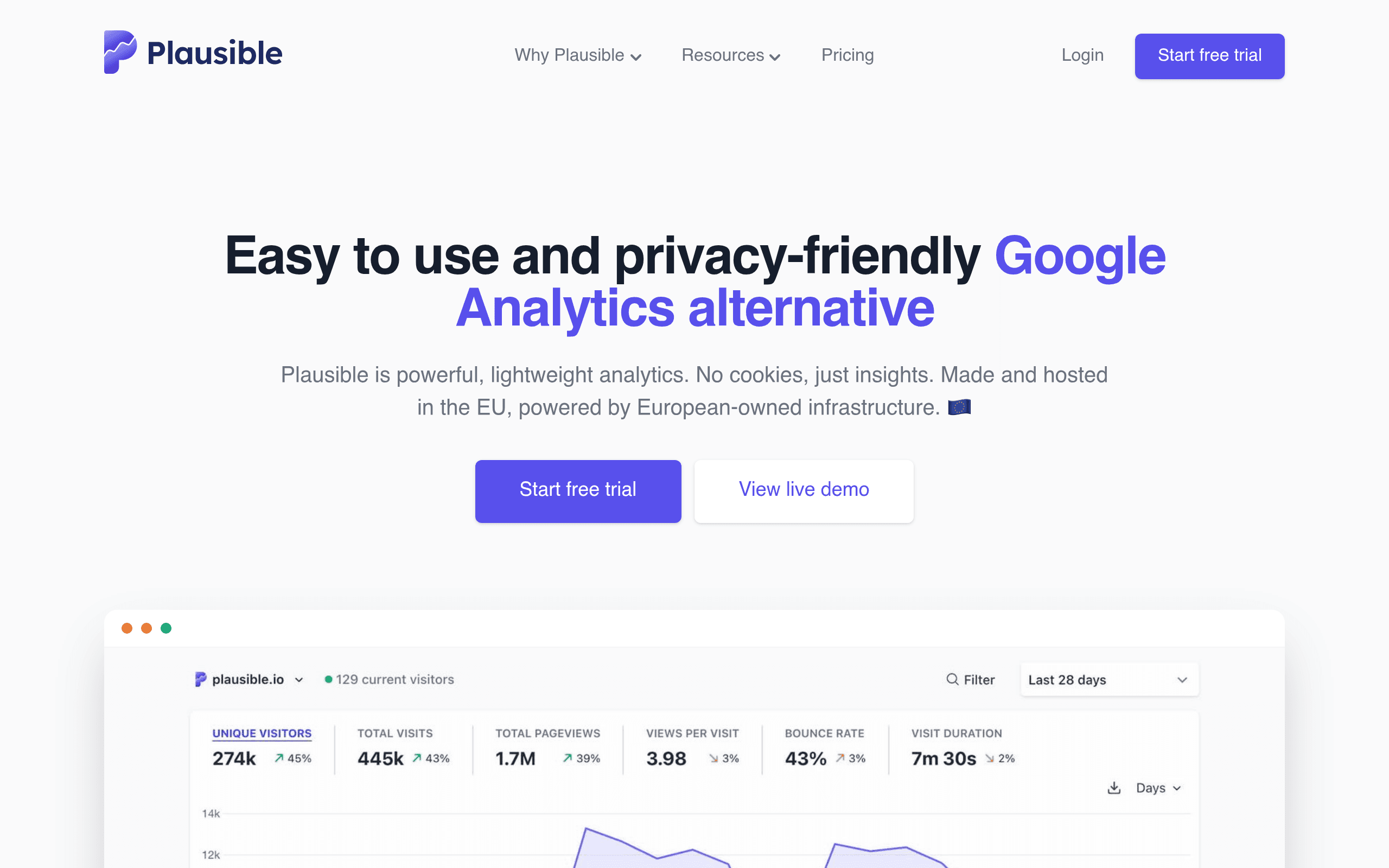
You installed Google Analytics four years ago, promised yourself you would learn it properly, and have since ignored it while quietly worrying whether your cookie banner actually works. Plausible exists for exactly this situation — and it fixes the problem better than anything else at this price.
Who Should Use Plausible Analytics
A five-person marketing agency billing European clients needs this. GDPR compliance is not a nice-to-have — it is a liability question. Plausible runs without cookies, which means no consent banner, no awkward pop-up asking visitors to agree to tracking they do not understand, and no compliance paperwork.
A solo consultant running a WordPress site sits dead center of the target market. You do not need funnel visualizations or heatmaps. You need to know where visitors come from, which pages they read, and whether they filled out your contact form. Plausible answers those three questions on a single screen in eight seconds.
European e-commerce businesses with simpler catalogs — a boutique clothing brand moving 200 orders a month — will find the goal tracking adequate. Plausible starts to break down if you run a Shopify store with hundreds of SKUs and need product-level conversion data. That requires different tools entirely.
What It Actually Does
Plausible shows you who visits your website, where they came from, what they looked at, and whether they did what you wanted — signed up, clicked a button, made an inquiry. That is it. It does this without dropping tracking cookies on visitors' browsers, which is why you do not need their permission.
The dashboard is one page. You see real-time visitor numbers at the top, traffic sources below that, most-visited pages next, then location data and device breakdown. Scroll down and you hit your goals. The whole picture loads in under two seconds. After watching business owners squint at Google Analytics 4 trying to find the Acquisition report, seeing someone open Plausible for the first time is almost funny — the data is just there, immediately readable, requiring no training.
You can track specific actions on your site, set up custom events, and share your dashboard publicly if you want clients or team members to see it without needing a login.
Pricing
Plausible charges based on monthly pageviews, not features. No free plan exists, which will annoy some people, but the $9/month entry tier covers up to 10,000 pageviews. For most service businesses and small blogs, that works. At this tier you get everything — no features locked behind higher plans.
The $19/month tier covers 100,000 pageviews. Most small businesses should be on this tier within their first year of growth. It remains good value compared to enterprise analytics alternatives without sacrificing functionality.
Higher pageview tiers scale upward from there, and the pricing remains reasonable without nasty jumps. Self-hosting is available if you have technical resources in-house — it eliminates the monthly fee entirely, though someone has to manage the server. For most small businesses, pay the $19 and spend your energy elsewhere.
What Works Well
The dashboard works on day one. No onboarding call, no tutorial video, no consultant required. You paste a script tag into your site, wait 24 hours, and your data appears. The real saving is the zero learning curve for anyone who needs to check numbers but is not an analytics professional.
Compliance is built in, not bolted on. Because Plausible does not use cookies and does not collect personal data, you are not managing a legal requirement — it is already handled. For any business with European visitors, this removes a genuine operational burden that other tools create and then sell you add-ons to manage.
Shared dashboards build client trust fast. A freelancer or agency can give clients a live link to their site's traffic data without creating accounts or explaining reports. Clients like the transparency. It is a small feature that changes how the relationship feels.
What Does Not Work
Goal tracking requires manual setup that trips up non-technical owners. Custom events need JavaScript added to your site. It is not complex, but if you have never touched code, you will need help. For a tool that sells simplicity, this friction feels wrong.
No Google Ads integration exists. If paid search drives meaningful traffic, you will hit a wall. Plausible cannot pull in cost data or show you which campaigns convert. You need a separate tool, which undermines the case for consolidating your reporting here.
The data can feel thin for complex businesses. If you need to understand user behavior across multiple touchpoints or analyze conversion paths that span weeks, Plausible will not give you enough detail. It shows you what happened, not why it happened.
How It Compares
Google Analytics 4 is free and extraordinarily detailed, but the learning curve is steep and the privacy exposure is real. Choose GA4 if you need deep funnel analysis, have Google Ads spend to track, or require detailed e-commerce reporting. Choose Plausible if compliance matters and simplicity is worth $9 a month.
Fathom Analytics is the closest direct competitor — similar privacy positioning, similar pricing, similar philosophy. Fathom's interface is slightly cleaner; Plausible's goal tracking is slightly more flexible. Either works. Pick whichever dashboard you find easier to read after a free trial.
Matomo is the self-hosted analytics veteran. It is far more detailed, far more complex, and carries meaningful setup costs. Matomo makes sense for businesses that need GA4-level depth but cannot use Google's infrastructure. For everyone else, it is overkill.
The Verdict
If you run a service business, agency, blog, or content-led brand and you want to know what works on your website without hiring someone to decode it — use Plausible. If you are a European business owner who has been quietly hoping your cookie banner provides enough protection, this removes that problem entirely. If you spend real money on Google Ads and need to see which campaigns drive revenue down to the keyword level, use GA4 and accept the complexity. If you run a high-volume Shopify store with detailed product analytics needs, look at something purpose-built for e-commerce. For everyone else — and that is most small businesses — Plausible is the right call at a price that is easy to justify. Nine dollars a month for analytics you will actually open every week is one of the better software decisions available right now.
Common Questions
Does Plausible require a cookie consent banner?
No. Because Plausible does not use cookies and does not collect personally identifiable information, GDPR and PECR do not require you to display a consent banner for analytics. This is one of the primary reasons European businesses choose it over alternatives.
Can I migrate from Google Analytics to Plausible?
You can run both simultaneously during a transition period, which most users do for 30 to 60 days to compare numbers. Plausible does not import historical GA data, so your old reports stay in Google Analytics — you start fresh on the Plausible side.
Is the $9/month plan enough for a small business website?
For most small service businesses, yes. The 10,000 pageview monthly limit covers a typical professional services or consulting site comfortably. If you run a busy blog or generate significant traffic from content marketing, move to the $19 tier early rather than waiting until you hit the ceiling.
Can my team or clients see the analytics without a Plausible account?
Yes. You can share a public or password-protected dashboard link. Anyone with the link can view the data in real time without needing to log in or hold a paid seat. For agencies reporting to clients, this is one of the more practical features in the product.