Who Should Use Triple Whale
You run a Shopify store, you spend $5,000 or more per month on Facebook and Google Ads, and you cannot tell which campaigns are actually profitable once you account for shipping, returns, and cost of goods. That is Triple Whale's exact purpose. A founder-led brand doing $500K a year in revenue with a two-person marketing team will get more immediate value from this tool than almost any other analytics platform.
Performance marketers managing ad accounts for DTC clients will find this useful. Rather than toggling between Meta Business Suite, Google Ads, and a Shopify dashboard that shows revenue but not profit, everything sits in one place. The attribution layer alone changes how you interpret campaign performance — particularly for brands where the customer journey spans several days and multiple touchpoints.
If you run a service business, a B2B company, or anything that does not sell physical or digital products through Shopify, stop reading. This tool was designed for a specific operator, and that focus is one of its strengths.
What It Actually Does
You spend $3,000 on a Facebook campaign. Facebook says it generated $12,000 in revenue. Google claims credit for $8,000 of the same sales. Your Shopify dashboard shows total revenue of $10,000. None of those numbers agree, and none tell you what you actually made after product costs and shipping.
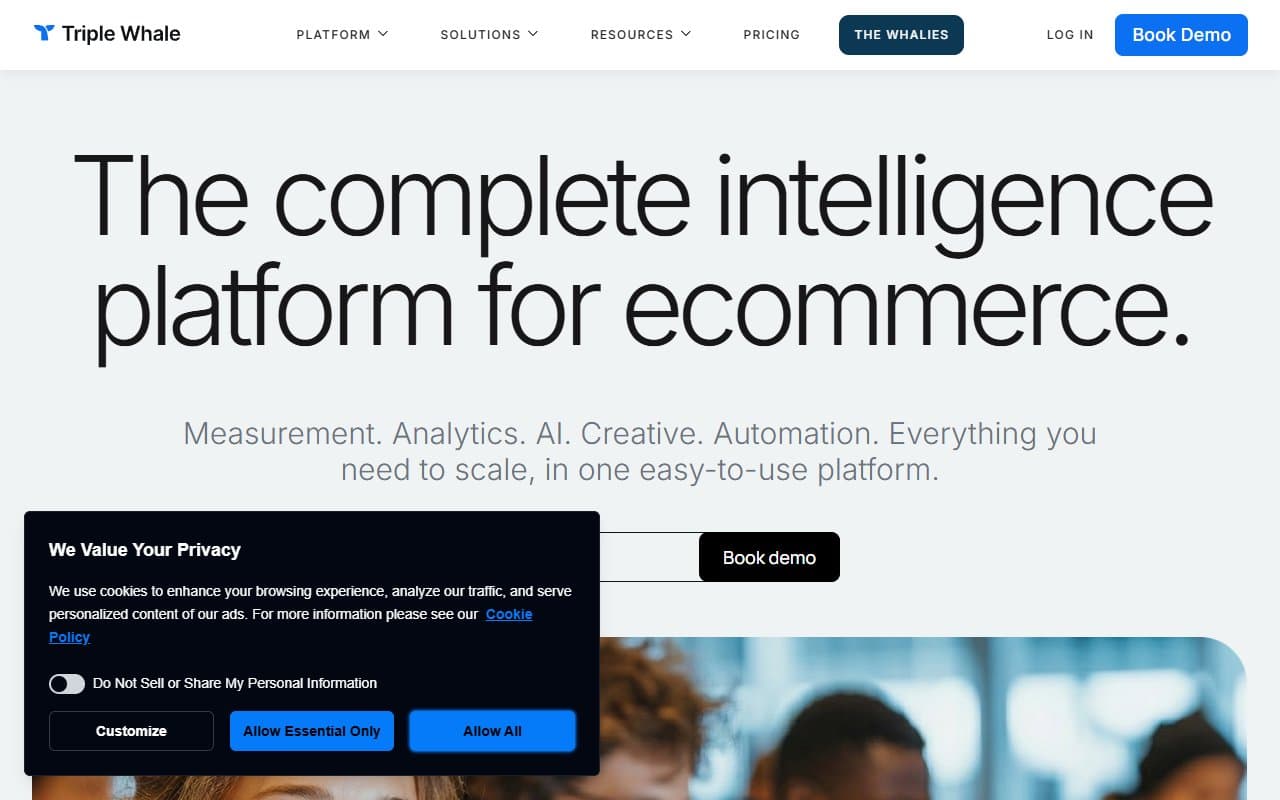
Triple Whale pulls all of that together. It connects to your Shopify store, pulls in your ad platforms, and builds a profit dashboard that shows real margin — not just top-line revenue. Its attribution model tracks where customers actually came from, rather than letting each platform claim full credit for every sale. The AI assistant, Moby, lets you ask questions about your data in plain English and get answers without digging through reports.
Pricing
Triple Whale's entry point at $129/month gets you the core dashboard, Shopify integration, and basic attribution. For a store doing under $1M annually, this tier covers most of what you need day-to-day.
Higher tiers unlock deeper attribution modeling, the full Moby AI feature set, and more detailed creative analytics. Pricing scales with your store's revenue, which can sting as you grow — some brands report their bill doubling within a year simply because revenue increased, not because they used more features.
There is no free plan and no meaningful free trial. For a $129 starting price, that is a genuine weakness. Most competitors offer at least a 14-day trial. You buy before you understand what you are buying.
What Works Well
The profit dashboard is the real product. Most analytics tools show you revenue. Triple Whale shows you what you actually kept. Seeing true margin by channel, by campaign, and by product in one view saves a small marketing team three to four hours a week in manual reconciliation.
Attribution that does not flatter your ad platforms. Facebook will always tell you your ads are working. Triple Whale uses first-party data from your Shopify store to give you a more honest picture. Brands routinely discover that campaigns they thought were profitable are breaking even or worse once Triple Whale's attribution replaces platform-reported numbers.
Moby surfaces problems you would miss. The AI assistant is not just a chatbot bolted on for marketing purposes. Ask it why your ROAS dropped last Tuesday, and it will cross-reference your ad spend, refund rate, and shipping costs to give you a specific answer.
What Does Not Work
The learning curve is steeper than the onboarding implies. Triple Whale sells itself as plug-and-play, but getting attribution set up correctly — particularly the pixel configuration — takes time and attention. Get it wrong and your data is misleading from day one. Smaller teams without a dedicated marketing operator sometimes spend weeks before they trust the numbers.
The price scales against you. Revenue-based pricing sounds fair until your store has a strong quarter and your Triple Whale bill jumps with no change in your actual usage. For a bootstrapped brand managing cash flow carefully, that unpredictability is a real problem.
How It Compares
Northbeam targets a similar audience and has stronger multi-touch attribution modeling for brands with complex, longer sales cycles. Triple Whale is faster to set up and the profit dashboard is more intuitive — choose Northbeam if attribution accuracy is your obsession, Triple Whale if you want the full profitability picture faster.
Rockerbox is another serious competitor, particularly for brands running a wider mix of channels including TV and podcasts. Triple Whale wins on Shopify depth and ease of use. Rockerbox wins on channel breadth.
The Verdict
If you run a Shopify store, spend real money on paid ads, and you are currently making budget decisions based on what Facebook tells you — use Triple Whale. The profit dashboard will change how you operate within the first month. If you are pre-revenue, spending less than $2,000 per month on ads, or selling services rather than products, the price is hard to justify.
Triple Whale is not perfect, and the revenue-based pricing model deserves scrutiny before you sign up. But for the specific operator it was built for, it is the most practically useful analytics platform for e-commerce today.
Common Questions
Does Triple Whale work with Shopify?
Yes — Shopify integration is the foundation the entire platform is built on. Setup connects your store in under an hour, though configuring the attribution pixel correctly takes more care and is worth doing slowly.
Is Triple Whale worth it for small stores?
At $129/month, it makes financial sense once you spend at least $3,000 to $5,000 per month on paid advertising. Below that threshold, the attribution insights are less actionable and the cost is harder to justify.
How accurate is Triple Whale's attribution?
More accurate than relying on individual ad platform reporting, which over-claims credit. No attribution tool is perfect, but Triple Whale's first-party data approach is more reliable than Meta or Google's native dashboards for multi-channel brands.
Can I cancel Triple Whale easily?
Triple Whale operates on monthly or annual billing. Monthly plans can be cancelled without penalty. Annual plans carry a commitment, so test thoroughly before locking in twelve months — especially given there is no free trial.