Who Should Use Capsule CRM
A five-person bookkeeping firm that needs to track client conversations, follow-up tasks, and deal stages — without dedicating two days to setup — is exactly who Capsule was built for. Same goes for a freelance consultant managing 40 active client relationships, or a small nonprofit tracking donor contacts and grant pipelines on a tight budget.
Where it breaks down is anywhere a team is actively trying to scale. A 15-person SaaS startup with a sales development rep, an account executive, and a manager wanting pipeline reporting by rep, lead source, and close rate will hit Capsule's ceiling within a month. It wasn't designed for that workflow.
Small agencies, trades businesses, independent consultants, and nonprofits are the sweet spot. If your pipeline has fewer than five stages and fewer than ten people actually touch the CRM, Capsule is worth your time.
What It Actually Does
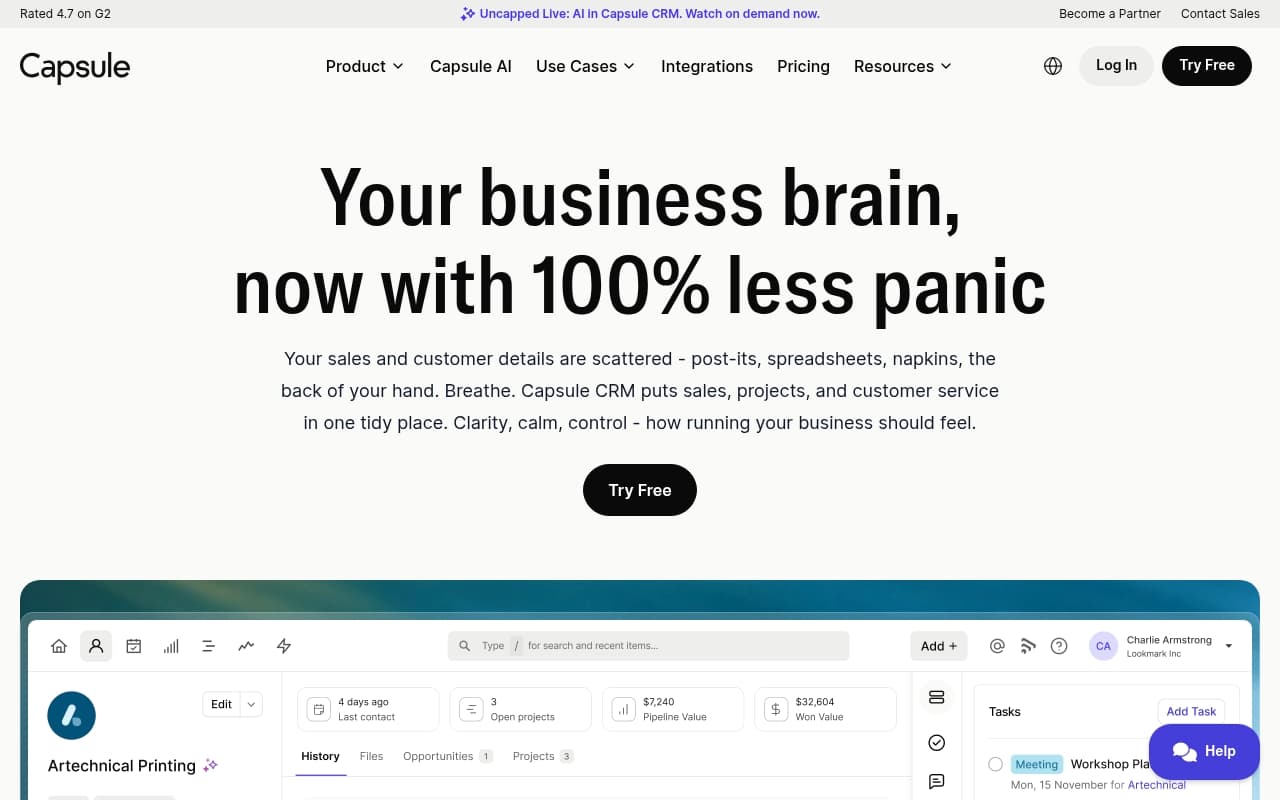
Think of Capsule as a tidy address book that grew into a sales tool. You store contacts — people and organizations — and attach notes, tasks, emails, and files to each one. When a contact becomes a potential sale, you move them into a pipeline and track where the deal stands.
The calendar and task view keeps daily follow-ups visible, which sounds simple until you realize how many CRMs bury this under three menus. Email connects to Gmail and Outlook so messages attach to the right contact automatically. Zapier links Capsule to your invoicing software, forms, and email marketing tools.
What Capsule doesn't do is automate sequences, score leads, or run workflows without that Zapier workaround. It organizes relationships — it doesn't process them.
Pricing
Free plan covers 250 contacts and two users. Fine for testing, but 250 contacts disappears fast. Not viable long-term for anyone actively selling.
Starter at $18/user/month unlocks 30,000 contacts, task management, and basic reporting. For a one or two-person operation, start here.
Growth at $36/user/month adds sales reporting, multiple pipelines, and activity reporting. Most small businesses should pick this tier — multiple pipelines alone justify the jump if you manage different service lines or client types.
Advanced at $54/user/month includes workflow automation and custom fields. At this price you're approaching HubSpot's Starter territory, and HubSpot does more. Unless you're already committed to Capsule and need specific features, this tier doesn't make sense.
What Works Well
The setup time is actually fast. Most CRMs promise simplicity and deliver configuration nightmares. Capsule delivers a working setup in under an hour — import contacts, create pipeline stages, connect email. Most teams are operational the same day.
The contact timeline is useful. Every email, note, task, and file sits in chronological order per contact. Before a client call, you can scan six months of interaction history in thirty seconds. That context saves embarrassing conversations and wins repeat business.
Tasks don't disappear. The daily task view surfaces what needs doing today without burying it. For a solopreneur juggling ten active clients, that visibility alone is worth the subscription cost.
What Doesn't Work
There's almost no native automation. Want a new lead to automatically get a welcome email, trigger a task for your team, and appear in a specific pipeline stage? You're doing all of that manually or building it in Zapier. Businesses sending even moderate outbound volume will find this limiting.
Reporting is thin. The Growth tier adds sales reporting, but the data depth is limited. You can see how many deals are in each stage and projected revenue. You can't easily see conversion rate by source, average time in stage, or rep performance breakdowns. If your manager asks sales performance questions beyond "how many deals do we have," Capsule will frustrate you.
How It Compares
HubSpot CRM is free at a more generous scale and adds marketing tools, email sequences, and better reporting at paid tiers. Choose HubSpot if you need automation or plan to grow your sales team in the next 12 months. Choose Capsule if HubSpot's complexity gets in your way and you want something you'll actually use.
Pipedrive sits in a similar price range but is built around pipeline management, with stronger reporting and better activity tracking. A dedicated sales team should pick Pipedrive. A service business managing relationships — not purely chasing deals — often finds Capsule more natural.
The Verdict
If you run a small service business, manage donor relationships for a nonprofit, or work solo with a book of clients — use Capsule. Setup is quick, contact management is clean, and you won't spend your first week configuring things that should work out of the box.
If you have a dedicated sales team, run outbound campaigns, or need to report pipeline performance to stakeholders, use Pipedrive or HubSpot instead. Capsule doesn't try to be everything, which is both its limitation and its most honest quality. For the business owner who needs a CRM they'll actually open every day, it delivers.
Common Questions
Does Capsule CRM work with Gmail?
Yes — the Gmail integration attaches sent and received emails to the relevant contact automatically. There's also a Chrome extension that surfaces Capsule data inside your Gmail inbox, which saves switching between tabs constantly.
Can you use Capsule CRM for free?
You can, but the 250-contact limit makes it impractical for most businesses beyond an initial trial. If you have an active client list of any meaningful size, you'll need a paid tier within the first few months.
Is Capsule CRM good for nonprofits?
It's one of the better fits in this price range. Nonprofits managing donor relationships, grant pipelines, and volunteer contacts will find the contact and deal management structure maps naturally onto those workflows. Capsule also offers a nonprofit discount worth asking about directly.
How does Capsule CRM handle team collaboration?
Contacts, notes, and tasks are shared across your team, so everyone sees the same client history. What it doesn't do well is assign deals with clear ownership or track team performance in any meaningful way — so if accountability across a sales team matters, that gap will surface quickly.