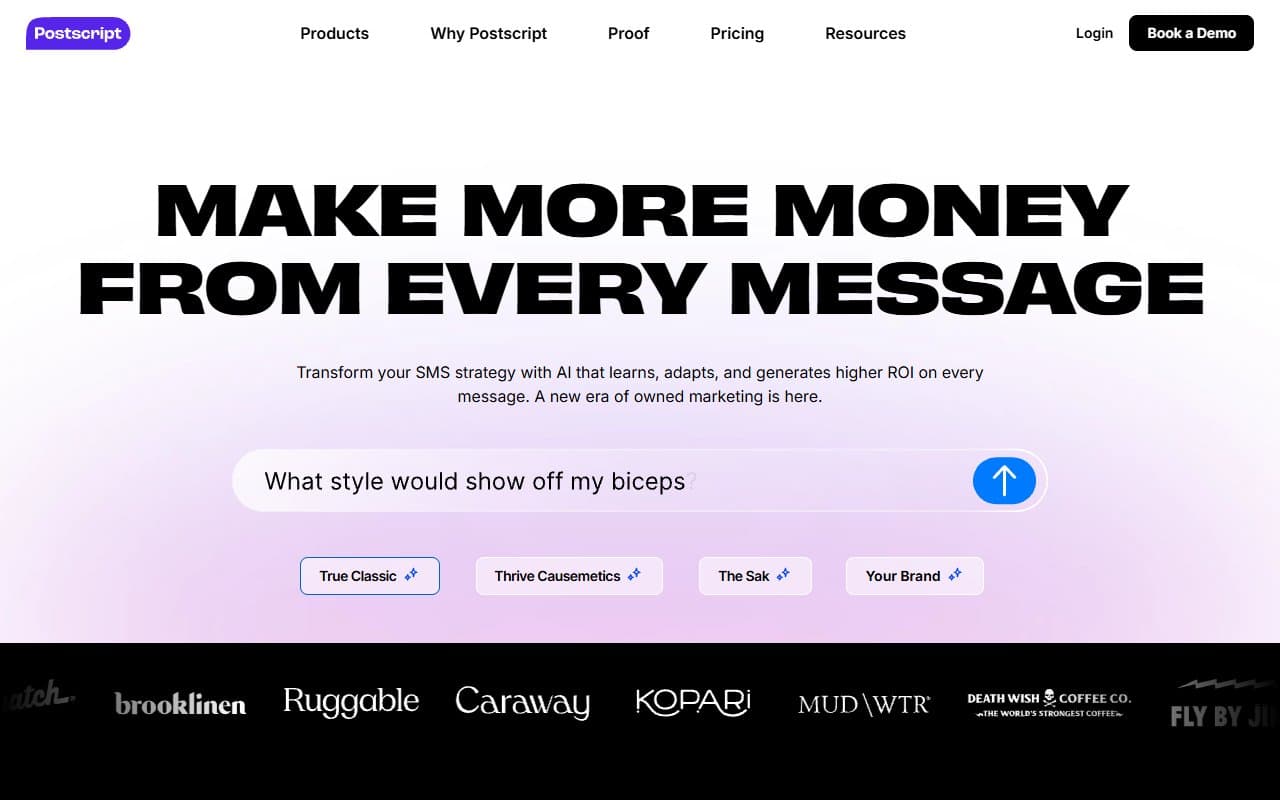
Your email open rates hit 22% on a good day. Your SMS open rates could hit 98%. Most Shopify store owners know this gap exists and do nothing about it — usually because every SMS tool they've tried feels bolted together or treats Shopify as an afterthought. Postscript was built Shopify-first.
Who Should Use Postscript
Direct-to-consumer Shopify brands — apparel, supplements, home goods, beauty, anything with repeat buyers — should pay attention. The platform works for stores where customer lifetime value matters, meaning you're bringing customers back in 30, 60, and 90 days, not just closing one sale. A 10-person skincare brand doing $800K annually on Shopify has exactly the subscriber list and purchase frequency to make conversational SMS profitable.
Subscription brands get the most value. If you're managing recurring orders through Recharge or similar Shopify-native subscription apps, Postscript's segmentation targets subscribers based on billing cycles, churn risk, and product history. Most SMS platforms ignore this.
Where Postscript doesn't belong: WooCommerce stores, B2B operations, or multichannel sellers. The platform assumes Shopify as your commerce layer. Without it, you lose most of what makes Postscript worth paying for.
What It Actually Does
Postscript connects to your Shopify store and sends text messages to customers — but think of it as the SMS equivalent of Klaviyo. You build automated flows triggered by shopping behavior: abandoned carts, post-purchase check-ins, back-in-stock alerts, win-back sequences for customers who haven't bought in 90 days. The segmentation runs deep enough to message only customers who bought a specific product, spent over a certain amount, or live in a particular region.
The two-way conversational SMS feature lets your team reply to customers in real time — handling pre-purchase questions or complaints without routing everything through email. Analytics attribute revenue clearly, so you see exactly how much money a specific campaign generated, not just clicks. Compliance runs at the platform level, which matters when you're building a subscriber list at scale.
Pricing
Postscript runs on freemium. The free plan gives you access to core features but limits monthly messages — enough to test flows and learn the interface, not enough to run a real program. Treat it as a trial.
Paid tiers scale based on SMS credits consumed monthly rather than flat subscriber fees, which is honest pricing if your sending volume is predictable. Most small Shopify stores sending 10,000–50,000 messages monthly land in the mid-tier range. That pricing is reasonable given what comparable tools charge and the Shopify-specific functionality.
Higher tiers unlock advanced features including dedicated customer success and granular analytics. For stores under $1M annual revenue, start with the entry paid tier and grow into the advanced options.
What Works Well
Deep Shopify integration. This isn't a generic SMS tool with a Shopify plugin — every segment, trigger, and automation connects directly to your order and customer data. You can build a flow targeting customers who purchased a specific SKU twice in six months without touching a spreadsheet.
Conversational SMS that scales. Most platforms let you broadcast. Postscript lets you have two-way conversations at volume, with a shared inbox your team can manage. For brands where pre-purchase questions are common, this turns SMS into a sales channel.
Revenue attribution you can trust. The analytics attribute revenue to specific campaigns with clear, configurable attribution windows. You know which message made money and which didn't. That clarity changes how you make decisions about future campaigns.
What Doesn't Work
Non-Shopify users are locked out. This isn't a soft limitation — Postscript depends architecturally on Shopify. If you migrate platforms or run multichannel operations, you'll rebuild your SMS program from scratch somewhere else.
Steep learning curve. The segmentation is deep, but takes time to master. New users often underuse the platform for months because the options feel overwhelming. There's no quick-start workflow guiding you toward the highest-ROI automations first.
How It Compares
Klaviyo SMS makes sense if you're already deep in Klaviyo for email — the unified customer data view helps. But if SMS is your primary channel rather than email's sidekick, Postscript's SMS-specific depth wins.
Attentive targets enterprise DTC brands and prices accordingly. For stores doing under $2M annually, Attentive is oversized and overpriced. Postscript fits better at that stage.
The Verdict
If you run a Shopify store with a real customer list and want SMS to contribute meaningfully to revenue, Postscript is the right tool. The Shopify integration removes the friction that kills most SMS programs before they start, and the segmentation means you send relevant messages rather than blasting everyone with the same offer.
If you're pre-revenue, running WooCommerce, or selling B2B, Postscript won't serve you — try ManyChat instead. For everyone else, the free plan costs nothing to test and most stores see measurable ROI within the first two automated flows.
Postscript is what SMS marketing for Shopify stores should look like.
Common Questions
Does Postscript work with non-Shopify stores?
No. The platform is built around Shopify's data infrastructure and won't function without it. If your store runs on another platform, you need a different tool.
Is the free plan actually useful?
For evaluation, not operation. You'll understand the interface and can set up your first automation, but message limits mean you can't run a real program. Expect to move to paid once you start growing your subscriber list.
How does Postscript handle SMS compliance?
Compliance tools are built in — opt-in management, quiet hours, TCPA-related safeguards. You still need to understand the rules for your region, but Postscript handles mechanical enforcement so you're not managing it manually.
Can my team handle customer replies at scale?
Yes. The conversational SMS inbox works for teams, with assignable conversations and shared queues. For two or three people managing customer communication, it works without chaos.