Who Should Use Make
If you've never automated anything and just want Google Form responses in a spreadsheet, stop here. Make is overkill — like hiring a Formula 1 mechanic to change a tyre.
Make clicks for a 5-person agency managing campaigns across six platforms, where someone understands conditional logic and doesn't flinch at "data mapping." It works for solo e-commerce operators tired of Zapier's per-task fees on high-volume workflows. A business running 50,000 monthly operations pays far less on Make.
Small dev shops and SaaS companies moving data between systems with precision — catching errors, branching on conditions, handling edge cases — will find Make feels purpose-built.
What It Does
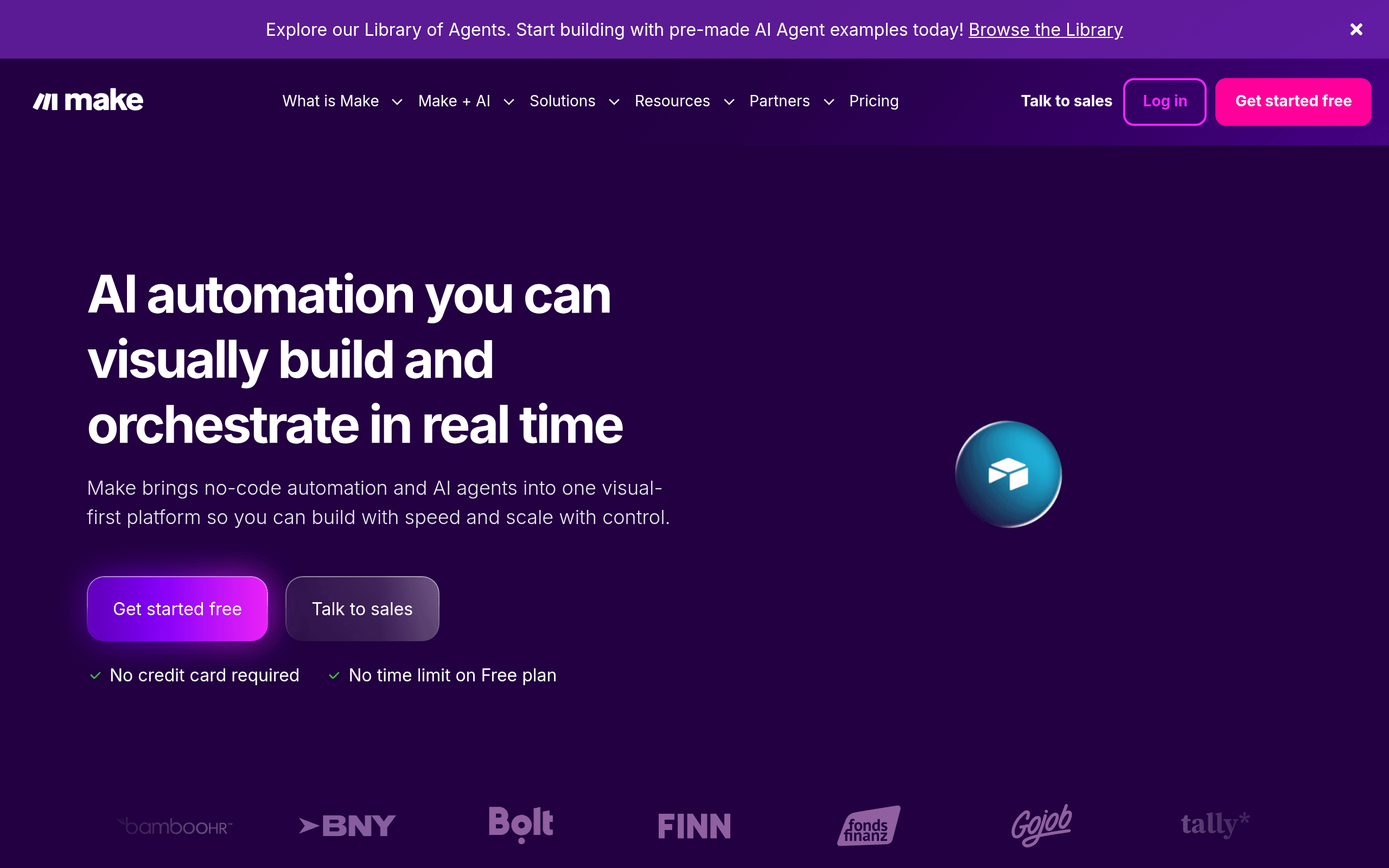
Make builds automated workflows ("scenarios") on a visual canvas. Drag, connect, and configure steps like drawing a flowchart where each shape acts: pulls CRM data, formats it, sends it elsewhere, checks if it worked.
The logic layer separates Make from basic automation tools. Build branches — if this condition is true, do that; if not, do something else. Loop through records, store data temporarily, set error handlers so failed steps don't kill entire workflows, trigger scenarios on schedules or via webhooks. Over 1,500 app integrations cover most small business tools. The HTTP module connects anything with an API.
The visual layout is Make's strength and weakness. You see exactly what your automation does. You must also think clearly before building.
Pricing
Free plan: 1,000 operations monthly, 2 active scenarios. Test the tool properly but don't run real business on it.
Core — $9/month: 10,000 operations, unlimited scenarios. Start here. Genuine value at this price.
Pro — $16/month: 40,000 operations plus priority execution, custom variables, full-text search. Upgrade when you're debugging frequently or running time-sensitive workflows.
Teams — $29/month: Adds collaboration features. Worth it once two or more people build and maintain scenarios.
Operations-based pricing beats Zapier's task model for high-volume use. Operations add up faster than expected when scenarios include filters and routers — monitor usage early.
What Works
Visual builder shows reality. Most workflow tools display linear step lists that mask what's happening. Make's canvas reveals branching paths, loops, error routes as they exist. When something breaks, you see exactly where.
Error handling for real businesses. Most automation tools fail silently or send vague emails. Make builds specific error routes — when an order fails to sync, automatically flag it in Slack and log to a sheet rather than discover the problem three days later. Non-negotiable for businesses where data accuracy matters.
HTTP and webhooks included. Zapier charges extra for webhook access. Make includes it from day one. Removes barriers for businesses connecting industry-specific tools or custom systems.
What Doesn't Work
Learning curve is steep, documentation patchy. Make's help center has gaps. Some modules are well-documented; others leave you reverse-engineering logic from forum posts. Budget several hours before building anything business-critical.
Templates are thin. The template library promises more than it delivers. Many entries are minimal starting points requiring significant configuration. Zapier's templates come complete for common workflows.
How It Compares
Zapier learns faster and deploys quicker for simple two-step automations. Better templates for common small business workflows. Choose Zapier for speed. Choose Make for complexity and cost efficiency.
N8n matches Make's capability and offers self-hosting for data-sensitive businesses. Harder to set up, requires more technical comfort. Make occupies the middle ground between Zapier's simplicity and n8n's flexibility.
The Verdict
For businesses with genuinely complex workflows — orders triggering multiple actions, data moving between several systems, conditions determining next steps — Make delivers more capability per dollar than competitors. The $9 Core plan offers real value.
Starting from zero and need something running by Friday? Use Zapier. Make demands genuine learning investment. Worth making, but it's real investment.
Zapier user hitting task cost limits or logic ceilings? Make is the obvious move. Migrate your most expensive scenarios first, learn the canvas, expand from there.
Make is honest about what it demands and priced fairly for what it delivers.
Common Questions
Is Make suitable for someone with no coding experience?
Depends on comfort with logic, not code. If conditional statements and data mapping feel intuitive, you'll make progress without writing code. If the free plan's builder confuses you after an hour, this tool isn't right now.
How does Make's pricing compare to Zapier for high-volume automation?
At high volumes, Make costs substantially less. Businesses running tens of thousands of monthly operations typically pay 2-4x more on equivalent Zapier tiers. The gap widens as volume increases.
Can Make connect software not in its app library?
Yes, through HTTP module and webhooks. If software has an API — most modern business tools do — you can connect it without waiting for native integration. Requires comfort reading API documentation.
What happens if a scenario fails mid-run?
Make logs errors with detail about location and data involved. Built error handlers activate automatically. Without error handling, failed operations log but don't retry unless configured manually.