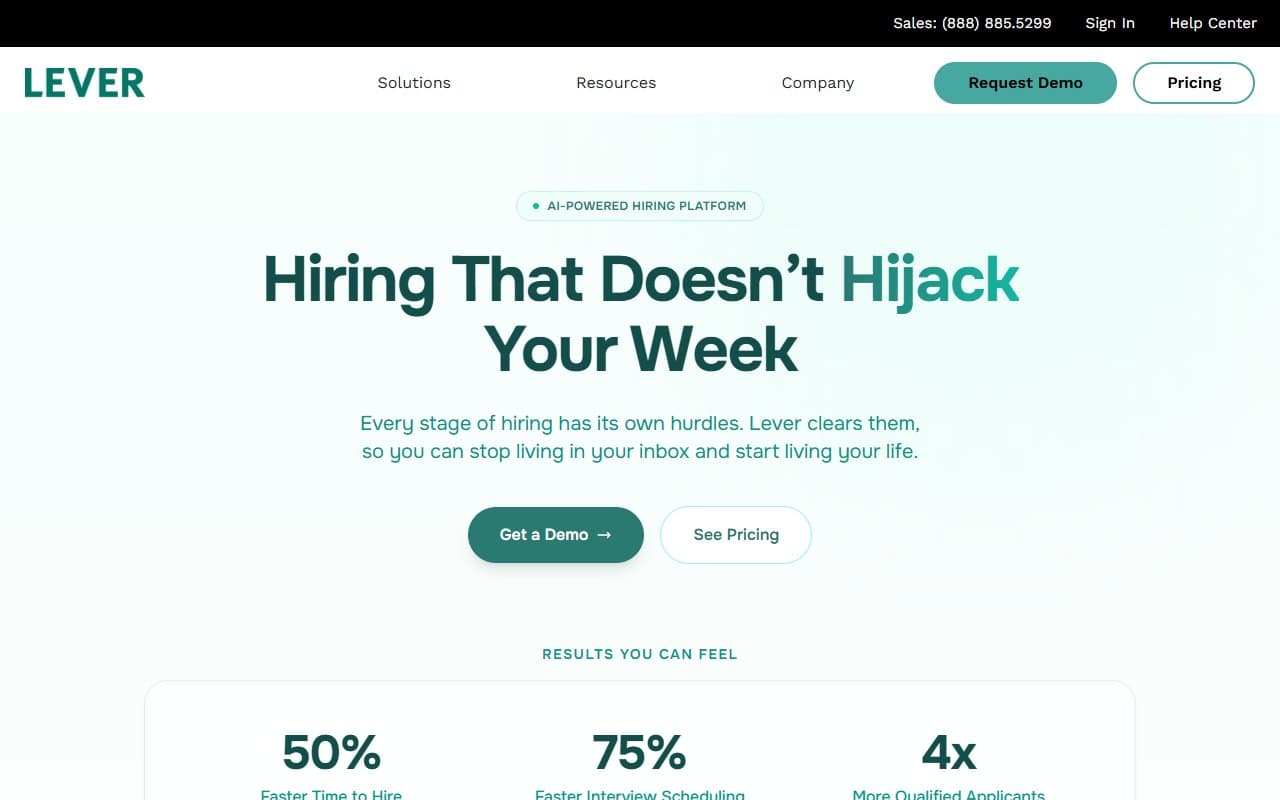
You've got three roles open, a spreadsheet that died two months ago, and qualified candidates disappearing because nobody followed up. Lever fixes this — if you're the right kind of business.
Who Should Use Lever
Lever fits tech companies hiring regularly — think a SaaS startup adding five engineers this quarter, or a digital agency scaling its team. You need hiring volume that justifies a real system, and you need someone who owns the process.
A dedicated recruiter or HR manager changes the equation completely. Lever rewards people who think in pipeline stages and structured interviews. If that's you, you'll wonder how you managed with spreadsheets.
Lever does not work for the 6-person consultancy where the founder reviews CVs between client calls. The platform assumes process maturity. Without it, you're paying to stay disorganized in a more expensive way.
What It Actually Does
Lever combines an applicant tracking system with candidate relationship management. The ATS handles job postings, applications, interview stages, offers. The CRM builds talent pools of people who weren't right today but might be perfect in six months.
NurtureBot sends automated outreach sequences to passive candidates — drip email for your talent pipeline. Interview scheduling syncs with calendars and kills the back-and-forth. DEI analytics track diversity data across your funnel. Reporting shows you where candidates drop off.
Everything lives in one place instead of across four tabs and a dying spreadsheet.
Pricing
Lever hides its pricing behind sales calls. Market data suggests most small businesses start around $317 monthly. No free plan. No trial.
That price works if you hire regularly — three to five hires per quarter probably justifies the cost within a month. Hiring twice yearly? Probably not. The lack of transparent pricing is genuinely annoying. Having to call sales before seeing the product is exactly the friction small business owners hate.
What Works Well
The CRM layer matters. Most ATS tools treat rejected candidates as dead ends. Lever tags and nurtures them over time. Your next hire might already be in your pipeline. For tech companies fighting over the same talent pool, that's real advantage.
Interview scheduling removes actual work. Calendar sync is reliable, automated reminders land correctly, candidates get a clean experience. This saves most recruiting teams three to five hours per open role — time that used to go to email ping-pong.
DEI reporting shows actionable data. The dashboard reveals where diversity drops off in your funnel. That's the kind of information that changes hiring behavior, not just satisfies annual reports.
What Does Not Work
Setup punishes small businesses. Getting Lever configured — stages, templates, automations, permissions — takes real time and expertise. New users hit a steep learning curve, and onboarding support varies. If you're planning to go live in a weekend, think again.
Pricing opacity serves Lever, not you. Forcing every prospect through sales before revealing costs is vendor-friendly, customer-hostile. Competitors publish their tiers openly. The opacity makes comparison shopping harder than necessary.
How It Compares
Workable starts around $189 monthly with published pricing. If you want capable ATS functionality without the CRM depth — and prefer not calling a salesperson — Workable is more straightforward. Lever wins on talent pipeline management and automation.
Greenhouse is Lever's closest competitor at this level. Greenhouse has stronger structured interview tools; Lever's CRM runs deeper. If candidate nurturing matters to your business, choose Lever. If interview consistency and scorecards matter more, start with Greenhouse.
The Verdict
Use Lever if you're a tech company or scaling business with 20+ employees and dedicated recruiting capacity. The ATS-CRM combination solves real problems, automation delivers measurable time savings, and DEI analytics beat most alternatives in this range.
Use Workable instead if you're a small team hiring occasionally or lack dedicated HR capacity. You'll get 80% of the functionality at lower cost with less overhead. Lever rewards operational maturity — it doesn't create it.
Lever works brilliantly for businesses ready for it, and frustrates everyone else.
Common Questions
Does Lever work for very small businesses?
No. Below 15 employees, or without dedicated hiring management, the sophistication becomes overhead rather than advantage. Very small businesses should try Workable or Breezy HR instead.
Is Lever worth the price?
For regular hiring, yes. More than six to eight hires yearly, the time saved typically covers subscription cost. For occasional hiring, the math doesn't work.
Can I try Lever before buying?
No free trial or self-serve signup. You must go through sales demo for access. Factor in that time cost when comparing tools.
How does Lever handle job postings?
Lever posts to major job boards from within the platform. All applications funnel into one place regardless of source, and it works reliably.