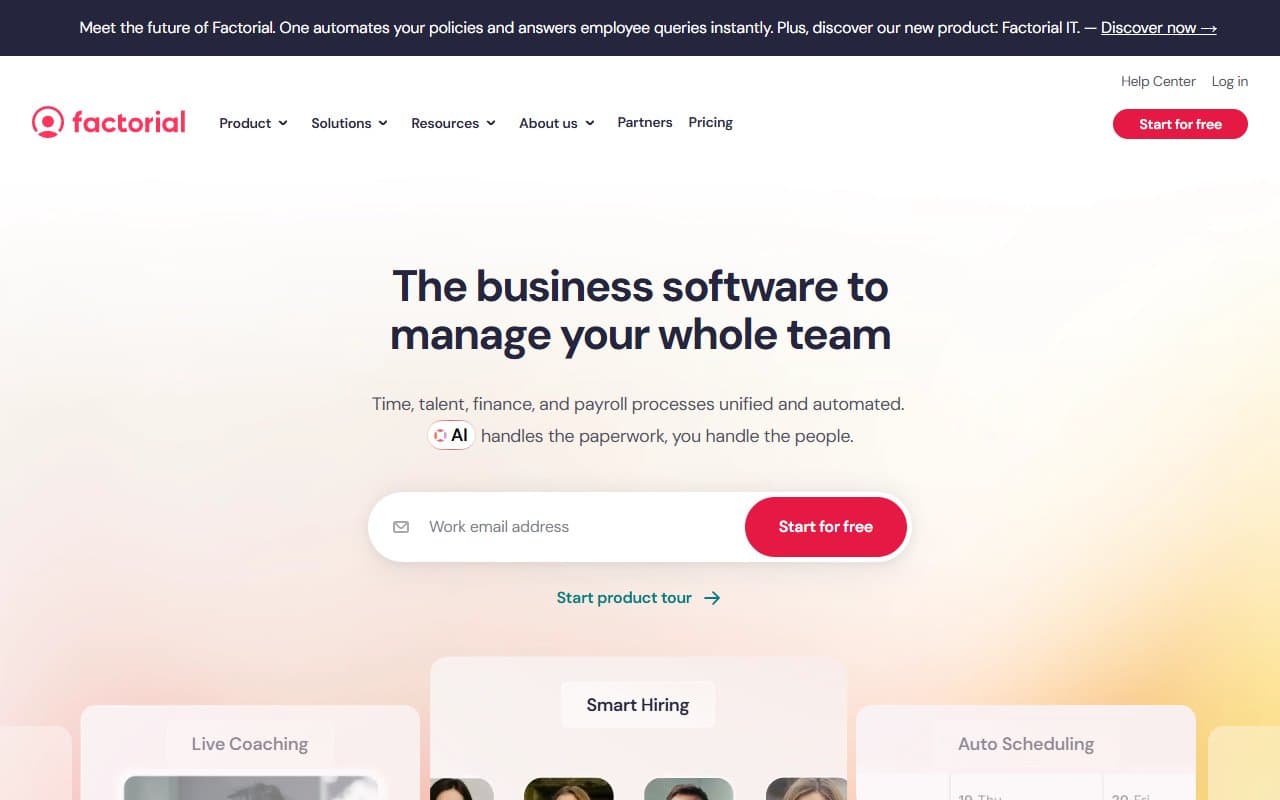
Most HR software sold to small businesses takes enterprise complexity and slaps a cheaper price tag on it. You pay less to be confused by the same bloated feature set.
Factorial takes a different approach. It handles the specific administrative burdens that hit European SMBs hardest: EU working time compliance, multi-country leave entitlements, and payroll structures that vary by jurisdiction.
Who Should Use Factorial HR
A 15-person architecture firm in Barcelona navigating Spanish labor law, or a 30-person SaaS company in Amsterdam managing Dutch payroll compliance — that's Factorial's target. It removes the weekly headache of keeping employment records accurate and legally defensible across EU jurisdictions.
Professional services firms get the most value. Consultancies, agencies, and legal practices that track billable time, manage contractors, and run quarterly reviews can handle all three in Factorial instead of stitching together separate tools with Zapier.
Don't use this if you're US-based. The payroll module reflects European tax structures and the compliance alerts reference EU frameworks. A 10-person Austin startup would pay for features they can't use while missing the local integrations they actually need.
What It Actually Does
Factorial centralizes everything that happens after you hire someone. Track who's off when, approve holiday requests, manage sick leave, and stay compliant with local working-hour rules — which are easier to violate in the EU than most founders realize.
Beyond daily operations, it processes payroll for European countries, runs performance review cycles, and includes a basic applicant tracking system. The compliance features actively alert you when contracts or time records look problematic, not just provide a checklist you'll ignore.
It replaces a shared Google Calendar for leave, payroll spreadsheets, paper-based reviews, and whatever free ATS you're currently tolerating. For most small teams, that consolidation alone justifies the monthly cost.
Pricing
Factorial charges $5 per employee per month for the base tier, which covers time tracking, leave management, and document storage. For a 10-person team, that's $50 monthly.
The mid-tier adds payroll, performance reviews, and the ATS — this is where most businesses should land. The base plan leaves out too much to work as a standalone HR system.
The top tier adds advanced analytics and dedicated support. Skip this unless you have over 50 employees. Don't let sales talk you into features you won't use.
Contact them directly for mid and top-tier pricing, as it varies by country and team size.
What Works Well
Leave management eliminates administrative ping-pong. Approval workflows take ten minutes to configure, and employees request time off through a mobile app. For a 20-person team, this removes an entire category of daily interruptions.
Compliance monitoring prevents legal problems. Factorial flags working-time violations before they escalate — something most HR tools ignore entirely. For EU businesses, these proactive alerts have genuine legal value.
Performance reviews actually get completed. Automated reminders and structured templates mean review cycles stop dying in managers' inboxes. Most teams report significantly higher completion rates once reviews live in the system instead of someone's calendar.
What Doesn't Work
Payroll coverage has gaps even within Europe. Not every EU country receives full support. If you operate across multiple European jurisdictions, verify exact payroll coverage before committing — the marketing promises more than the product currently delivers.
The ATS frustrates anyone serious about recruiting. It handles basic hiring at small scale, but you'll outgrow it within months if recruiting matters to your business. Pipeline reporting is minimal and candidate communication tools are bare. You'll end up running a dedicated recruiting tool alongside Factorial, which defeats the consolidation benefit.
How It Compares
BambooHR offers more polish and stronger US coverage, but costs significantly more and lacks native EU payroll. Choose BambooHR for US-based teams with higher per-seat budgets.
Personio provides broader EU payroll coverage and deeper compliance features. Factorial undercuts it on price and launches faster. If you need payroll complexity across five or more EU countries, Personio justifies the premium.
The Verdict
If you run a European business with 5 to 50 employees and currently manage HR through spreadsheets, email, and calendar chaos — Factorial replaces all of that at a reasonable price. For EU compliance and leave management pain points, this is a straightforward decision.
US-based teams should use BambooHR or Gusto instead. Neither suffers from market identity confusion.
Teams with serious recruiting needs should budget for a dedicated ATS alongside Factorial rather than expecting it to handle both jobs well.
Factorial isn't perfect, but for European SMBs wanting one sensible system instead of four mediocre ones, it delivers exactly what it promises.
Common Questions
Does Factorial HR work for UK businesses after Brexit?
Yes. Factorial supports UK employment structures including holiday entitlement under UK law, payslip requirements, and right-to-work documentation. UK payroll support is available — confirm current coverage with their team before signing, as this has expanded in recent releases.
Is there a free trial?
Factorial offers a trial period, not a permanent free plan. That's enough time to test whether time tracking and leave approval flows suit how your team works — where most teams make their decision.
Can employees use it without training?
The employee interface — requesting leave, submitting timesheets, viewing payslips — requires no training. Admin setup takes longer, particularly configuring leave policies and approval chains, but that's one-time work.
How long does setup take?
A 10 to 20-person team can be operational within a week. The main time investment is importing employee data and configuring your leave and working-time policies. If you have those documented already, setup accelerates considerably.