Who Should Use Bench
The most dangerous person in a small business is the owner who thinks they're on top of the books. You're not saving money doing bookkeeping yourself at 11pm on Sundays. You're spending your highest-value hours on your lowest-value task.
Freelancers billing over $5,000 monthly get the clearest return. At that income level, one tax mistake or missed deduction costs more than Bench charges annually. The dedicated bookkeeper knows your business, not just your transaction history.
E-commerce operators with simple product lines fit well, provided your inventory isn't complex. If you spend three hours weekly wrestling with Shopify reconciliations, Bench will feel like relief within the first month.
What It Actually Does
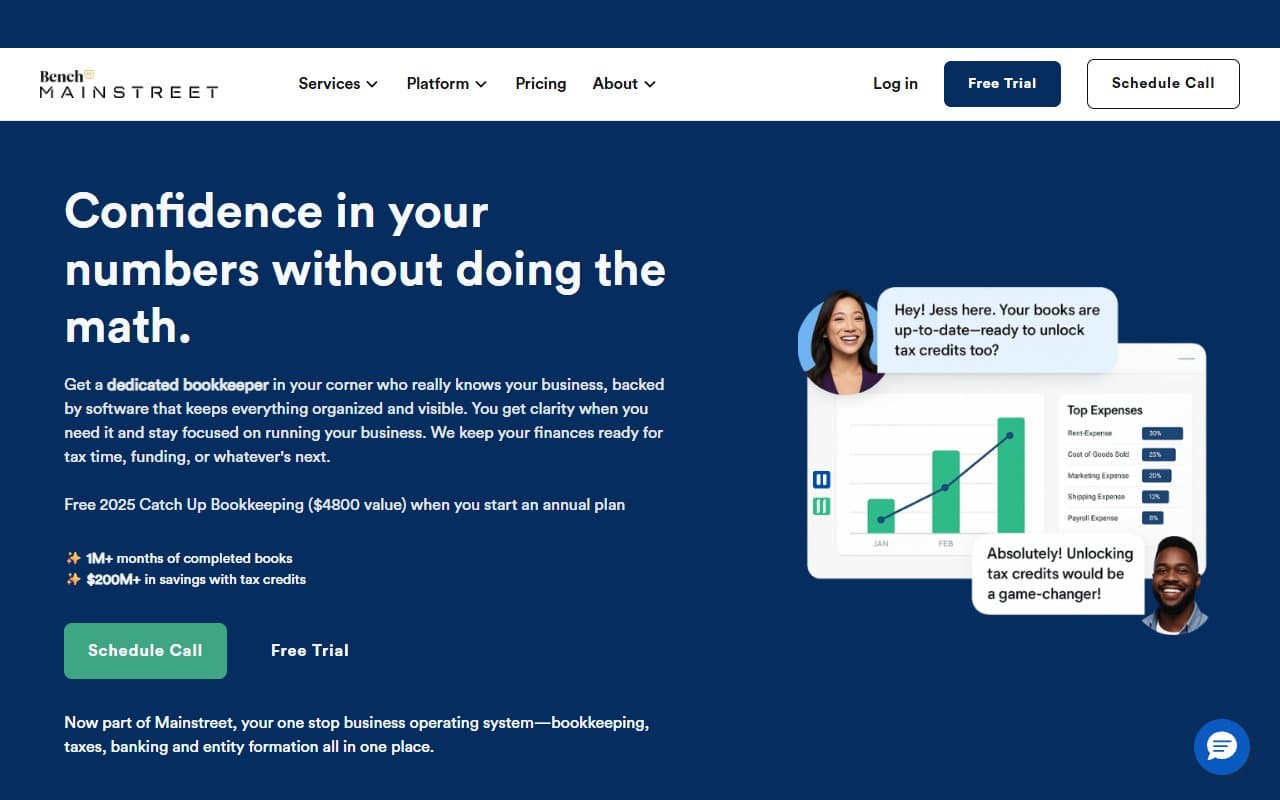
Connect your bank accounts and credit cards. Bench takes it from there. A real bookkeeper — not software, not a support queue — gets assigned to your account. They categorize transactions monthly, reconcile everything, and deliver readable financial statements.
AI handles pattern recognition: flagging recurring transactions, suggesting categories from merchant data, catching anomalies. The bookkeeper reviews that work, handles edge cases, and answers questions. AI does grunt work; humans make judgment calls.
At year-end, your books are clean enough to hand straight to a tax preparer. Bench will handle that too through their tax add-on. For businesses with messy historical records, they'll go back and fix prior periods — something DIY tools don't offer.
Pricing
Bench starts at $299/month, scaling up based on monthly expenses. This covers dedicated bookkeeping, monthly financials, and platform access. Tax filing costs extra.
The tax prep add-on makes sense if you don't have a trusted CPA. Bundling keeps everything in one place and avoids the annual scramble of handing off books to someone unfamiliar with your account.
For businesses above $20k monthly expenses, fees climb past $500. At that point, hire a part-time bookkeeper locally. Below $3,000 monthly expenses, the $299 flat fee hits too hard — poor value.
Buy the base tier at $299 if you're between $3,000-$20,000 monthly expenses. Add tax prep if you don't have a CPA.
What Works Well
The dedicated bookkeeper model works. Most software sells you tools and abandons you. Bench sells you an outcome. The same person handling your account monthly spots irregularities others miss — one user's bookkeeper caught a duplicate vendor charge that went unnoticed for eight months.
Monthly financials you can understand. The P&L statements and balance sheets are clean, clearly labeled, and designed for non-accountants. Open your dashboard Tuesday morning and know within minutes whether last month was good or bad.
Historical cleanup is genuinely useful. If your books are a mess — and for many new customers, they are — the back-reconciliation service is practical. Getting two years cleaned up before tax season is worth real money.
What Does Not Work
The price kills early-stage businesses. $299 monthly minimum equals $3,588 annually before tax prep. For a bootstrapped freelancer or new sole trader, that's brutal. No starter tier, no trial, no free plan. You commit from day one or you're out.
Complex inventory hits a wall fast. Bench handles straightforward service business bookkeeping well. Multi-location inventory, complex cost of goods, or manufacturing? The service strains. A furniture maker managing raw materials, work-in-progress, and finished goods across warehouses will find Bench underpowered. It's built for service businesses; product complexity is handled reluctantly.
How It Compares
QuickBooks Online costs less and gives you control. Choose it if you want to learn bookkeeping software. Choose Bench if you want the work done for you.
Pilot targets venture-backed startups with complex accounting needs and accrual reporting. Higher pricing, better for funded businesses with investor reporting requirements. Bench wins on simplicity for owner-managed businesses.
The Verdict
If you're a service business owner spending more than two hours monthly on books, Bench pays for itself in recovered time. A consulting firm, a designer billing $8k monthly, a simple e-commerce brand: all strong fits.
If you're budget-constrained and starting out, the entry price will hurt before value appears. Go with QuickBooks and a local bookkeeper until revenue justifies the jump. If you need accrual accounting or complex inventory tracking, Bench will eventually frustrate you.
The model — human judgment over AI efficiency — is right for most small businesses. The execution is solid. The price filters who can access it.
Bench is what happens when someone asks "what if bookkeeping just got done?" and builds the answer properly.
Common Questions
Does Bench replace my accountant?
Bench handles bookkeeping — recording transactions, reconciling accounts, producing monthly financials. Accountants handle tax strategy, business structure advice, and filing. Different roles. If you add Bench's tax service, you may not need a separate CPA for basic filing, but complex tax situations still need dedicated advice.
How long does setup take?
Most accounts connect and transfer to a bookkeeper within three business days. Historical cleanup takes longer — two to four weeks depending how far back you go. You're not waiting months for value.
What happens if I leave?
Financial data exports in formats a new bookkeeper can use. Switching isn't painless — it never is with financial data — but you're not locked in.
Is the bookkeeper responsive?
User reports show one business day response times for most questions, sometimes same-day. It's a real person, not a bot. During staff transitions, coverage can be inconsistent — some users report gaps when their bookkeeper leaves.