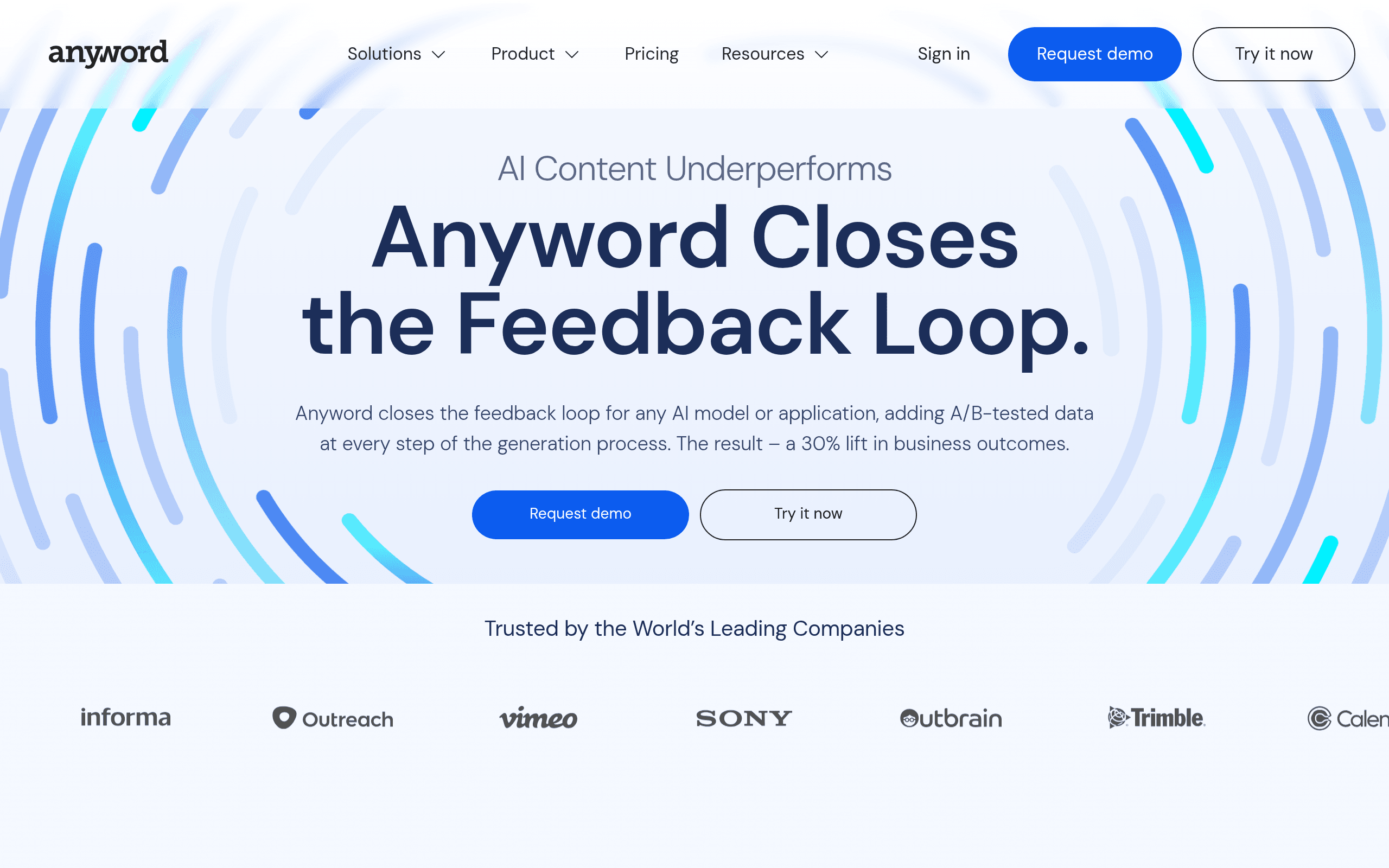
Who Should Use Anyword
If you run a Shopify store spending $3,000 or more a month on Meta and Google ads, Anyword will earn its subscription back quickly. The performance prediction score — which estimates how likely a piece of copy is to convert before you spend a dollar testing it — matters when you're making real decisions about ad spend. A five-person e-commerce team churning out product ads, landing pages, and email sequences every week will find the workflow faster and more informed than anything they're doing manually.
Growth teams at SaaS companies also get solid mileage here for A/B testing email subject lines and landing page headlines. If you're running drip campaigns and obsessing over open rates, having a tool that ranks your variants by predicted performance before you send changes how you make decisions. A team that currently guesses which subject line to use and a team using Anyword's scoring are having different conversations.
Where Anyword does not belong: a two-person branding agency, a restaurant trying to write Instagram captions, or anyone whose work requires a distinct creative voice. The tool optimizes for persuasion and conversion, not storytelling. If your copy needs to feel like a person wrote it, Anyword will fight you.
What It Actually Does
You paste in some context — your product, your audience, your goal — and Anyword generates copy options across formats like ads, landing pages, email subject lines, and blog posts. What sets it apart is the number sitting next to each output: a predicted performance score.
That score draws from a large dataset of real ad and copy performance across channels. It's Anyword's attempt to tell you, based on patterns from millions of campaigns, which version of your headline is more likely to get clicked. You can generate a dozen variants, see their scores side by side, and make an informed choice rather than going with your gut.
You can also input your own historical performance data, which sharpens the predictions for your specific audience. The more data you feed it, the less generic the recommendations become.
Pricing
Buy the Data-Driven plan at $79/month. The $39 Starter plan includes the core writing features and performance scores, but you'll hit the word limits and seat restrictions fast if you're running active campaigns. More importantly, you can't connect your own performance data on Starter, which means you're stuck with generic predictions.
The Data-Driven tier gives you 3 seats, higher limits, and crucially, the ability to import your campaign history to personalize the scores. Without that, you're working with aggregate data that's useful but not tailored to your business.
Business and Enterprise tiers exist but are overkill for teams under fifteen people.
What Works Well
The prediction score changes your behavior. When you can see that your second headline variant scores 23 points higher than your first, you stop arguing about it in Slack and just use the better one. Teams report fewer revision rounds and faster sign-off.
A/B variant generation is fast and specific. You're not getting five versions of the same sentence with a synonym swapped. The variants differ in angle and tone, which means you're testing real hypotheses rather than noise. For email subject lines especially, the spread of options is broad enough to be useful.
Channel-specific outputs hold up. Copy generated for a Google responsive search ad reads differently from copy generated for a landing page hero section. Anyword knows the formats and the character constraints.
What Does Not Work
The blog writing is forgettable. It's adequate, which is another way of saying it's not good. If your content strategy depends on articles that build authority or reflect a specific voice, the blog output here will feel thin. You'll spend more time editing than writing, which defeats the purpose.
Without your own data, the scores are educated guesses. The aggregate performance data beats nothing, but small business owners selling niche B2B services or hyper-local products will find the predictions less reliable. The tool calibrates on broad consumer and e-commerce patterns — your industry may not be well-represented.
How It Compares
Jasper AI is better for long-form content and brand voice consistency, but it doesn't have anything close to Anyword's performance prediction layer. If you write more blog content than ads, Jasper wins. If you run campaigns and need informed copy decisions, Anyword wins.
Copy.ai is cheaper and easier to start with, but it's a pure writing tool with no performance layer. For a business not running regular paid campaigns, Copy.ai at a lower price makes more sense. For anyone who is, Anyword's scoring is the difference that matters.
The Verdict
If you're running paid digital campaigns and making decisions about which copy to use based on instinct or whoever shouted loudest in the meeting, Anyword is worth trying. The $79 Data-Driven plan, connected to your actual campaign history, will pay for itself inside a month for most active advertisers. The prediction scores aren't magic, but they're measurably better than guessing, and over dozens of campaigns the compounding effect on conversion rates is real.
If you're not running ads, skip it entirely. Use the best writing & content tools for quick drafts, or a well-prompted writing tool. Anyword without the performance use case is an expensive way to generate copy you could get cheaper elsewhere.
Anyword is a specialist tool doing a specialist job well — respect what it is, don't ask it to be something else.
Common Questions
Does Anyword work for small businesses with no ad history?
Yes, but with reduced accuracy on the prediction scores. The aggregate dataset still gives you something useful to work with. Once you run a few campaigns and connect your data, the scores sharpen considerably. Start with the Starter plan and upgrade when you have data worth importing.
Is there a free trial?
Anyword offers a trial period before you commit. Given that this review is current as of 2026, confirm the trial terms on their site directly — these change. Don't buy without testing the prediction score on your own copy first, because that feature is the entire reason to choose this tool.
Can my whole marketing team use it?
On the Starter plan, seat limits are tight. A team of three or more needs the Data-Driven plan or above. Factor that into your cost comparison — what looks like a $39 tool quickly becomes a $79-plus tool once you add the colleagues who actually need access.
How accurate are the performance prediction scores?
Accurate enough to be useful, not accurate enough to be gospel. Think of them as a strong signal rather than a guarantee. Across a large volume of copy decisions they will improve your average output, but individual scores can be wrong. Use them to inform decisions, not make them automatically.